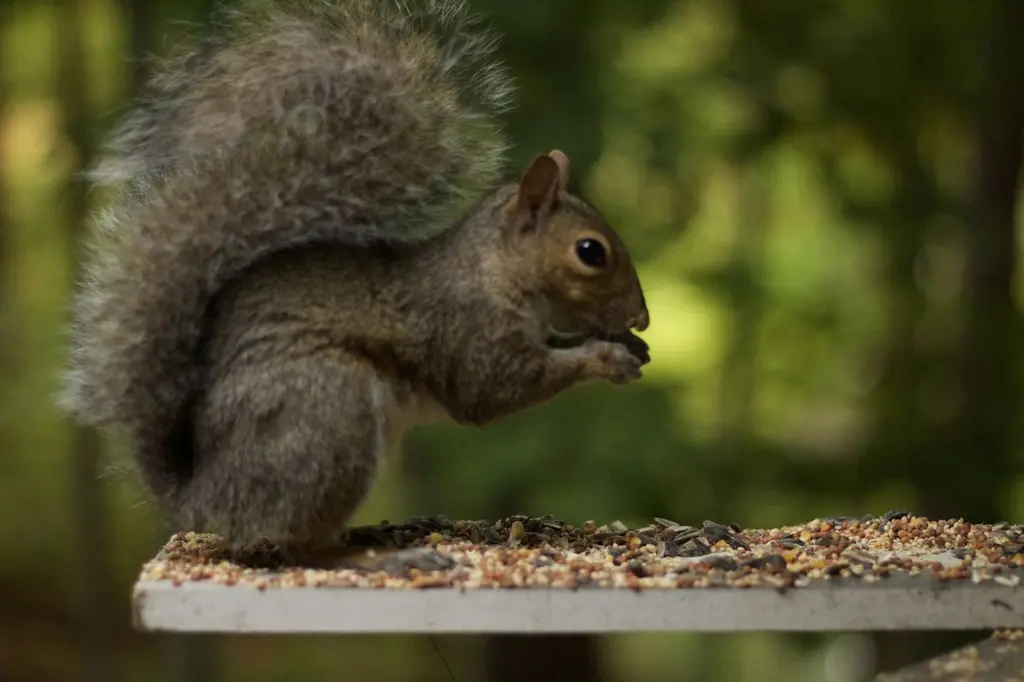
You fill the feeder in the morning, and by lunchtime there’s a squirrel sitting on the tray, tail flicking, looking perfectly at home. Annoying? Sometimes. But spend a few minutes watching, and it’s hard not to admire the skill involved.
The eastern gray squirrel (Sciurus carolinensis) is native to the eastern United States, reaching just west of the Mississippi River and north into Canada. People have also introduced it to western states and to parts of Europe, including Italy, England, Scotland, and Ireland. Mature woodlands are its favorite home, especially those with oaks and walnuts, but it does well in cities and suburbs too.
What to look for
Gray doesn’t quite cover it. The coat ranges from grizzled dark gray to pale gray and may have cinnamon tones.
An adult is about 15 to 21 inches long, with 6 to 10 inches of that being tail, and weighs roughly 12 to 26 ounces.
You may also spot an all-black one. Black squirrels are the same species, and they’re common in the northern part of the range. Animal Diversity Web reports that they lose 18% less heat than gray ones in temperatures below about 14°F, so that dark coat may help in a cold winter.
A menu that goes way beyond acorns
Gray squirrels feed heavily on the nuts, flowers, and buds of trees, including oak, hickory, pecan, walnut, beech, maple, and mulberry. That’s only the start. Their diet also includes:
- Fungi: including truffles, which matter more than you’d expect, as you’ll see below.
- Crops: corn and wheat.
- Insects: mainly in summer.
- The occasional surprise: bird eggs, nestlings, and frogs.
So if you find a squirrel near a bird’s nest, it may not just be passing through.
The scatter-hoarding system
Instead of keeping one big pantry, a gray squirrel spreads its food around in many small caches. Scientists call this scatter hoarding. The squirrel finds its food again using both memory and smell, which makes the habit far less random than it looks when one is digging up your flower bed.
That habit matters well beyond your yard. Caching may help spread tree seeds, since any buried seed that doesn’t get eaten has a chance to grow. A 2020 scientific review describes squirrels as seed dispersers in hardwood forests and links certain acorn characteristics to the decisions squirrels make about what to bury. The same review mentions an odd behavior called embryo excision, where a squirrel removes the embryo from a seed, reported in six squirrel species so far.
Gray squirrels may also help spread truffle spores when they eat truffles, so they do some quiet work underground as well.
Where they sleep and raise young
Look up in a big tree and you may notice a messy ball of leaves and twigs wedged in a crotch between branches. Gray squirrels use two kinds of homes: a den in a tree, and one of these leaf-and-twig nests, often 30 to 45 feet off the ground.
They breed twice a year, from December to February and again in May and June. After a pregnancy of 44 days, a female usually has 2 to 4 young, with litters arriving in late winter and midsummer. Newborns are naked and fully dependent on their mother. They’re weaned by about 10 weeks and reach adult size at around 9 months.
In the wild, the record lifespan is about 12.5 years, though that’s a maximum and not a typical life.
Reading a squirrel’s day
Timing helps if you want to watch them. For most of the year, activity peaks about 2 hours after sunrise and again 2 to 5 hours before sunset. In winter, the main peak comes 2 to 4 hours before sunset.
Those flicks of the tail are part of how they communicate, along with a range of calls. They also have a keen sense of smell and can pick up on another squirrel’s stress or breeding condition that way.
When a predator shows up, they give warning calls. It’s a real concern for them: mink, weasels, red foxes, bobcats, coyotes, and hawks all hunt gray squirrels. If you’ve got a red fox in the neighborhood, your squirrels have probably noticed.
Sharing the yard
Gray squirrels aren’t threatened, and Animal Diversity Web says they rank second only to birds in value to nature watchers. Not everyone is thrilled about them at the feeder, of course, and the seed they take is seed the birds don’t get. If you’re trying to strike a balance, our backyard birds guides are a good next stop.
Otherwise, a bit of patience goes a long way. Pull up a chair some late afternoon and watch one work. You’ll find more neighbors like this one in our animal fact files.
Sources: Animal Diversity Web: Sciurus carolinensis; Steele and Yi, Frontiers in Ecology and Evolution, 2020.