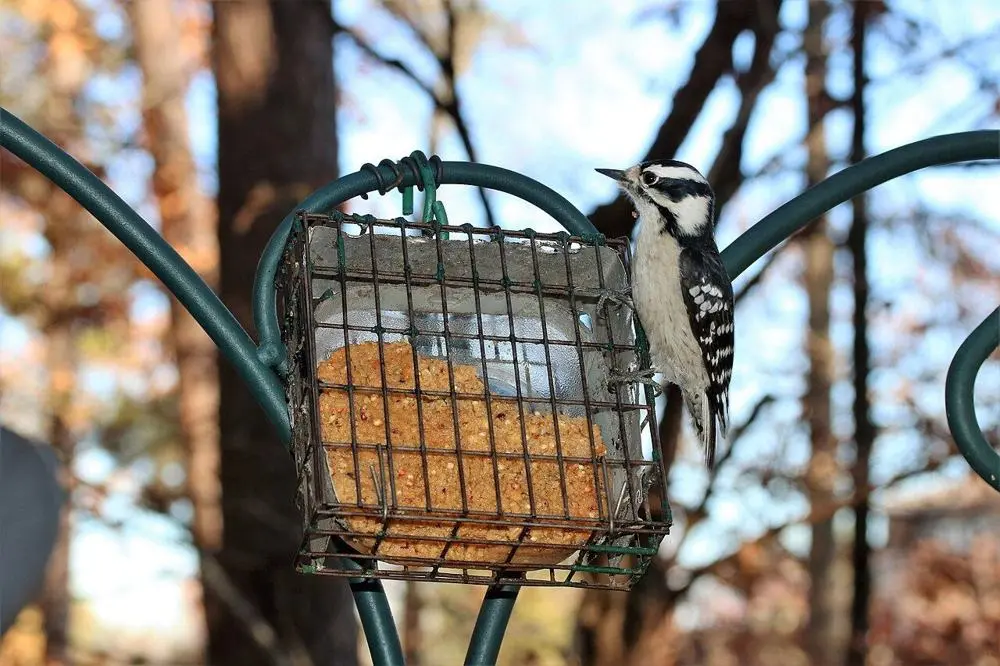
On a cold November morning, a small black-and-white bird lands on the suet cage, hitches itself sideways and starts chipping away at the block. There’s a sharp little pik, a flash of white down its back, and then it’s gone to the next tree.
That visitor is almost certainly a downy woodpecker. According to the Cornell Lab of Ornithology, it’s the woodpecker most likely to show up at a backyard feeder, and once you know it, you’ll notice it all winter long.
Meet the Downy Woodpecker
The downy woodpecker (Dryobates pubescens) is the smallest woodpecker in North America. It’s about 5 to 7 inches long and weighs well under an ounce, roughly sparrow-sized. Cornell notes that downies aren’t much bigger than the white-breasted nuthatches they often travel with.
Look for a white back, black wings checkered with white spots, a striped black-and-white face and a short, stubby bill. Males wear a small red patch on the back of the head. Females, like the one in the photo above, don’t have it.
Downies live year-round across most of the United States, skipping only the driest parts of the Southwest. Audubon notes that some of the northernmost birds move a little south in winter, while birds in western mountains may drop into the valleys.
Downy or Hairy? Telling the Look-Alikes Apart
The hairy woodpecker wears nearly the same black-and-white pattern, and Cornell calls the pair one of the first identification puzzles new bird watchers learn to solve. A few clues help:
- Size. The hairy is the bigger bird, around 7.5 inches long according to the National Park Service.
- Bill. The downy’s bill looks short and stubby for its head. The hairy’s is noticeably longer.
- Tail edges. Downies have small black bars on their white outer tail feathers, which you can sometimes see when one braces against a feeder.
- Voice. Downies give a soft pik and a descending, whinnying rattle.
What Downy Woodpeckers Eat
Suet may be what brings them to your yard, but downies are insect specialists at heart. The National Park Service reports that more than 75 percent of their diet is insects, especially beetle larvae and other grubs pulled from under bark, from plant stems and from galls. Ants, caterpillars and gall wasps are on the menu too, along with some seeds and berries.
Their small size lets them work places bigger woodpeckers can’t reach. Cornell describes downies balancing on weed stalks and hammering into goldenrod galls to get at the fly larvae inside. The Park Service also points to a study in which downies cut the overwintering population of codling moths, a serious apple orchard pest, by 52 percent.
In winter, males and females even split up the work. Cornell notes that males tend to forage on small branches and weed stems while females take the larger branches and trunks.
How to Bring Downies to Your Yard
- Offer suet. Cornell says downies prefer suet feeders but also take black oil sunflower seeds, millet, peanuts and chunky peanut butter. Our beginner’s guide to feeding birds in winter covers the basics.
- Leave some stems standing. Goldenrod and other tall perennials left up for winter can hold galls and insects that downies search out.
- Keep safe dead trees. Texas Parks and Wildlife notes that woodpeckers need dead trees for nesting and suggests leaving them standing when they don’t endanger people or property.
- Watch the mixed flocks. In winter, downies often travel with chickadees and nuthatches. Cornell explains that flocking means less time spent watching for predators and better luck finding food.
Drumming, Roosting and Nesting
Woodpeckers don’t sing. Instead, they drum loudly on wood or even metal, and Cornell points out that this drumming is a signal, not feeding. A downy digging for food is surprisingly quiet.
Each downy chisels out its own cavity to sleep in through the cold months, according to Texas Parks and Wildlife. Audubon reports that males and females keep separate feeding areas in fall and early winter, then pair up by late winter, taking turns drumming on dead limbs. The nest is a cavity dug in a dead limb or tree, usually 12 to 30 feet up, and its entrance is often ringed with fungus or lichen that helps hide it. Females lay about four or five white eggs, and the young leave the nest roughly three weeks after hatching.
Life is short for most small birds. The Park Service puts the downy’s median lifespan at one to two years, though the oldest known downy reached at least 11 years and 11 months. The good news is that the species is common and widespread, and Audubon reports no evidence of population declines. You can meet more of your feeder regulars on our Backyard Birds page.
A Small Bird Worth Noticing
The next time you hear a soft pik from the maple out back, look for the little black-and-white bird working the bark. With a block of suet and a few stems left standing, you can give it a reason to stop by all winter.
Sources: Cornell Lab of Ornithology, All About Birds, National Park Service, Shenandoah National Park, National Audubon Society Field Guide