You are watching the bee balm when something small zips in and stops in front of a bloom. Its wings are a blur, and it seems to hang in the air as it drinks. Your first thought is “baby hummingbird.” Then you notice the fuzzy body and the pair of antennae.
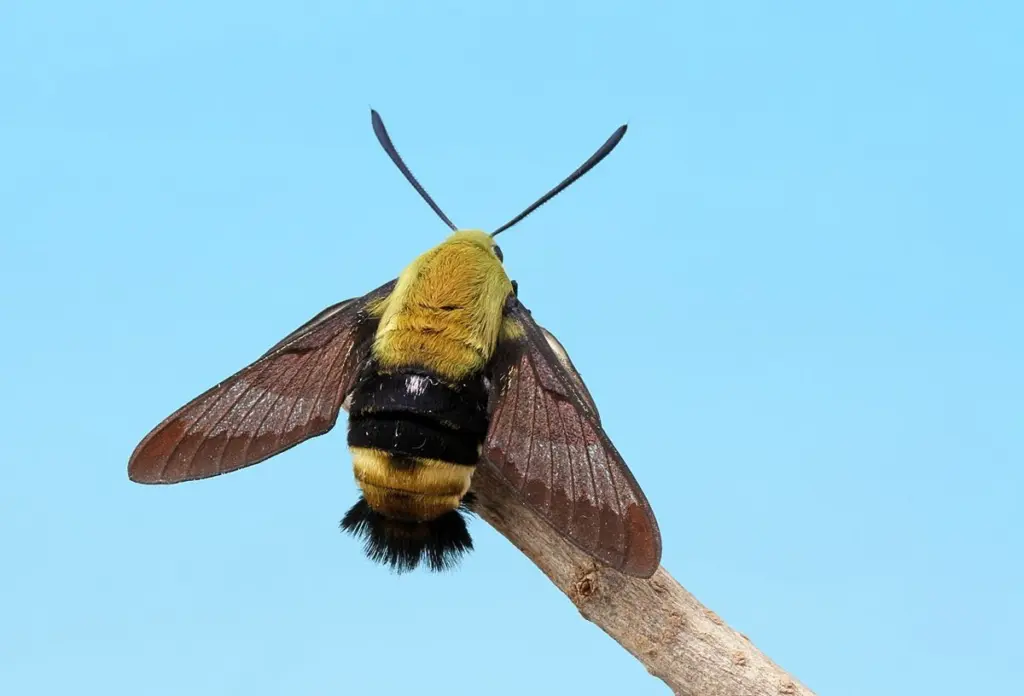
What you are looking at is a clearwing moth, and people often mistake them for hummingbirds. They also look a bit like bumble bees. For a moth that is out in broad daylight, that is quite a set of disguises.
Two common clearwings to know
Clearwings belong to the sphinx moth family. Two species are the ones you are most likely to hear about, and the Missouri Department of Conservation describes both:
- Hummingbird clearwing (Hemaris thysbe): the slightly larger of the two, with a wingspan of 1¾ to 2¼ inches. The body is fuzzy and olive to golden olive above, with a dark burgundy or blackish abdomen, and the legs are pale.
- Snowberry clearwing (Hemaris diffinis): a wingspan of 1¼ to 1¾ inches. The body is golden yellow, the abdomen has black and yellow bands, and the legs are black. A black band runs through the eye and along the side of the thorax.
If you get a good look, the legs are the easiest clue, since pale legs point to a hummingbird clearwing and black legs to a snowberry. A third species, the slender clearwing, is much less common in Missouri.
Animal Diversity Web says the hummingbird clearwing ranges as far north as Alaska and the Northwest Territories, west to Oregon and south to Florida and Texas, and that it is most common in the eastern United States.
How the wings turn clear
The name comes from the large central patches on the wings, which have no scales and let you see straight through them. Animal Diversity Web says the hummingbird clearwing’s wings start out dark red to almost black, and some of the scales fall off after the first flight. That leaves clear windows framed by a reddish to brown border.
So a freshly emerged moth can look quite different from one that has been flying for a while.
Moth, hummingbird or bee?
The hovering is what fools people. Clearwings usually do not land and walk over flowers the way bees do. They stay in the air and feed from a long tongue, called a proboscis, much as a hummingbird would.
A few things give them away:
- Antennae: birds do not have them. Clearwings have antennae that thicken from the base outward and curve at the tip.
- Fuzz: a clearwing’s body looks soft and fuzzy, much like a bee’s.
- Bee-like colors: the Missouri Department of Conservation says both species mimic bumble bees.
Clearwings are active during the day, which surprises people who think all moths come out at night. Even so, the hummingbird clearwing is noticed most often at dusk and dawn, and snowberry clearwings sometimes keep visiting flowers into the evening.
Flowers that attract them
Hummingbird clearwings particularly like flowers with long floral tubes. The sources we read name honeysuckle, bee balm, clover, phlox, vetch, lilac, snowberry and cranberry, among others. Snowberry clearwings visit a variety of flowers too. Both are often seen in gardens and suburban yards as well as woods and fields.
Honeysuckle needs one word of caution. Some non-native honeysuckles are invasive in parts of North America, so check what is recommended for your state. Coral honeysuckle is a native alternative in much of the East, and our native plants section has more ideas.
Caterpillars and winter
Clearwing caterpillars are hornworms, with a pointed “tail” at the back end. Hummingbird clearwing caterpillars are bumpy and green with a pale line down each side of the back, while snowberry caterpillars are usually green with black spots and a yellow collar behind the head.
Their food plants differ a little:
- Hummingbird clearwing: viburnums such as black haw and snowball, buckbrush (coralberry), and reportedly honeysuckle, snowberry, hawthorns, cherries and plums.
- Snowberry clearwing: buckbrush, snowberry, horse gentian, blue star, honeysuckles and dogbanes.
In Missouri, hummingbird clearwings have two or three broods a year and fly from early April into September, while snowberry clearwings usually have two broods and fly from late March into September. Animal Diversity Web gives May to September for the hummingbird clearwing, so expect the timing to vary with where you live.
When the season ends, hummingbird clearwings spend the winter in the soil as pupae, and snowberry clearwings pupate in a cocoon on the ground. That makes the ground beneath your plants worth a second thought before a heavy fall cleanup, and our article on leaving the leaves explains how to go about it.
Keeping an eye out
You cannot plan on a clearwing turning up, but a sunny bed of tubular flowers gives you a fair reason to linger. Look for the hover, then the antennae, and then, if it holds still long enough, the legs. And when a friend tells you they have seen a tiny hummingbird at their flowers, you might ask them what color its legs were.
Sources: Missouri Department of Conservation: Hummingbird Clearwing; Missouri Department of Conservation: Snowberry Clearwing; Animal Diversity Web: Hemaris thysbe.