Say “honeysuckle” to a lot of gardeners and they’ll groan. They’re thinking of Japanese honeysuckle, the vine that swallows fences and smothers whole woodland edges. But there’s a native honeysuckle that’s nothing like it, and it might be the easiest vine you’ll ever grow for hummingbirds.
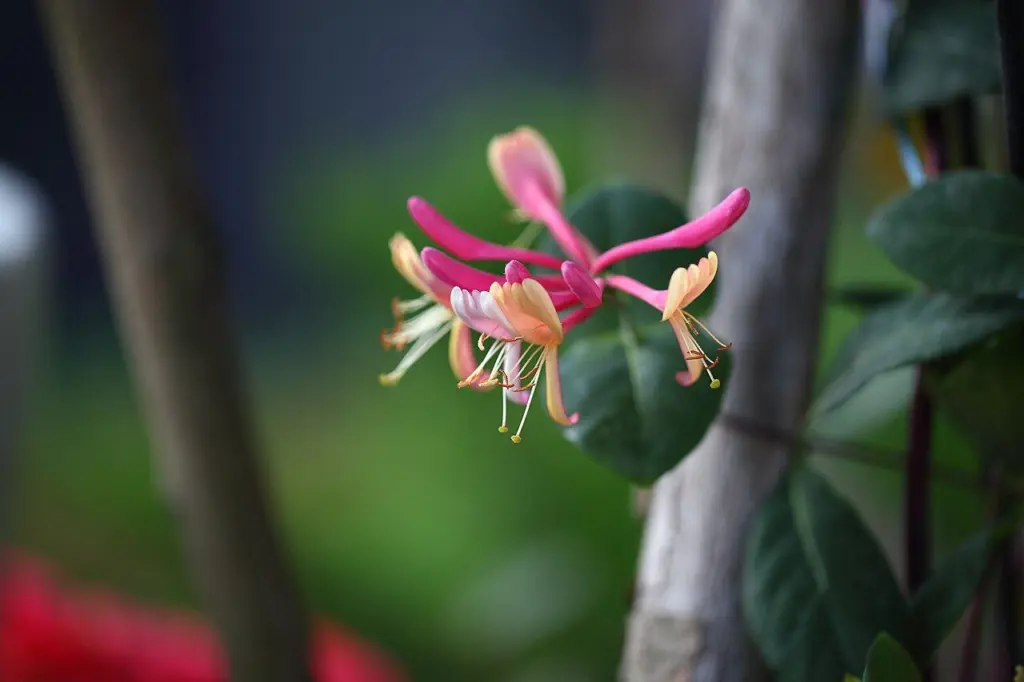
Coral honeysuckle (Lonicera sempervirens), also called trumpet honeysuckle, is native across much of the eastern and central United States. It climbs politely, blooms for months and doesn’t try to take over the neighborhood.
Native vs. Invasive: How to Tell Them Apart
It’s worth knowing the difference, because you may already have the invasive kind growing somewhere nearby.
- Flower color. Coral honeysuckle has long, narrow, coral-red trumpets with yellow-orange insides. Japanese honeysuckle (Lonicera japonica) has white flowers that fade to yellow.
- Scent. Japanese honeysuckle has that heavy, sweet smell people remember from childhood. Coral honeysuckle has little to no fragrance. It’s built for hummingbirds, which hunt by sight, not smell.
- The leaves under the flowers. This is the giveaway. On coral honeysuckle, the top pair of leaves just below the flower cluster is joined into one round leaf with the stem running right through the middle.
- Berries. Coral honeysuckle has red berries. Japanese honeysuckle has black ones.
Who Uses It
The tube-shaped flowers are a near-perfect fit for a ruby-throated hummingbird’s bill, and in the South it often starts blooming right around the time the first hummingbirds return in spring. Long-tongued bees and some butterflies visit too, and hummingbird clearwing moths (the ones people often mistake for tiny hummingbirds) are regulars.
Later in the season, the small red berries feed birds like American robins, purple finches and catbirds. The tangle of stems also makes a decent spot for small birds to tuck in a nest.
How to Grow It
- Sun. Full sun gives you the most flowers. It’ll grow in partial shade, but blooms less.
- Soil. Not fussy. Average, well-drained soil is fine. It handles some drought once it’s settled in.
- Support. It’s a twining vine, so it needs something to wrap around: a trellis, an arbor, a mailbox post or a chain-link fence. It won’t stick to bare walls.
- Size. Usually 10 to 15 feet over a few years, depending on what it has to climb.
- Hardiness. Roughly USDA zones 4 through 9. In warmer zones it may keep its leaves through winter, which is where the name sempervirens, meaning “always green,” comes from.
Expect the first year to be slow. The old saying about perennials holds here too: first year it sleeps, second year it creeps, third year it leaps. Once it gets going, the heaviest bloom comes in spring, followed by scattered flowers through summer and often a second flush in fall.
A Few Tips From Experience
- Prune right after the spring bloom. Trim back stems that are wandering or tangled. Avoid heavy pruning in late winter, or you’ll cut off the spring flowers.
- Give it air. Powdery mildew can show up in humid, crowded spots. Good airflow and a sunny location keep it in check, and it rarely does serious harm.
- Aphids happen. A spring flush of aphids on new tips is common. A blast of water usually handles it, and it’s a good snack for visiting warblers.
- Check the label. Named varieties like ‘Major Wheeler’ and ‘Alabama Crimson’ are popular, bloom heavily and are still coral honeysuckle. Just make sure the tag says Lonicera sempervirens.
If you have a bare fence or an empty trellis, give coral honeysuckle a try. It’s one of those plants that quietly does its job for years, and the hummingbirds will find it faster than you’d think.