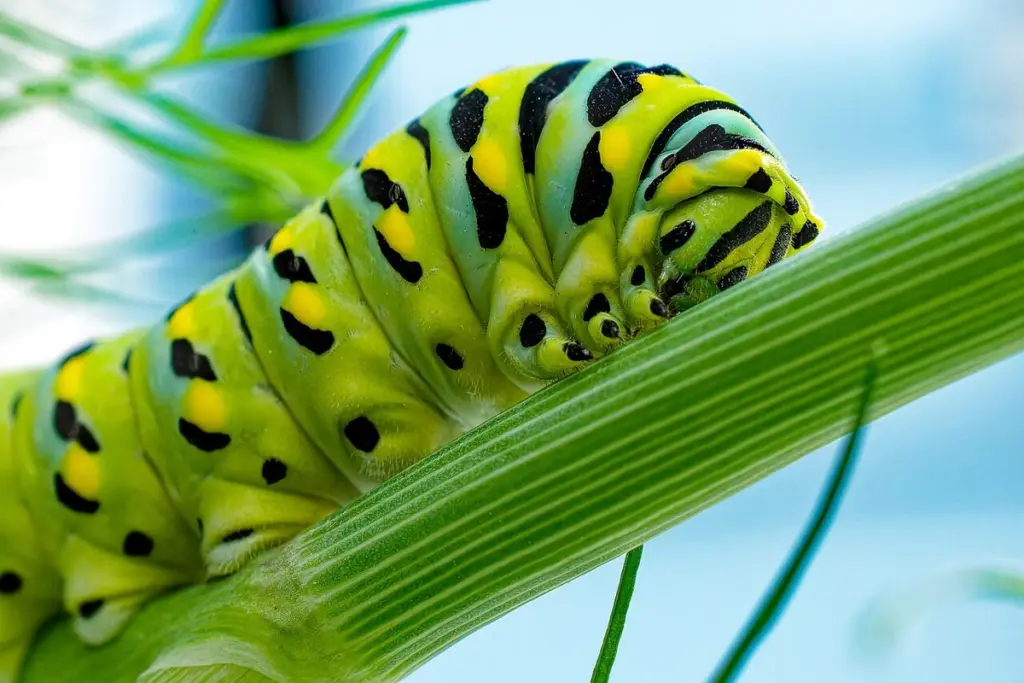
You head out to snip some parsley and find a plump green caterpillar banded in black and dotted with yellow, working its way down a stem. Nudge the plant and it may rear up and push out a pair of bright orange “horns,” along with an odd, sharp smell.
That’s the caterpillar of the black swallowtail, one of the most familiar butterflies in eastern North America. It isn’t something to panic about. It’s a butterfly in the making, and this time of year it’s also a good reason to go easy on the fall garden cleanup.
Meet the Black Swallowtail
The black swallowtail (Papilio polyxenes) goes by several names, including eastern black swallowtail and “parsley worm” for its caterpillar. University of Wisconsin–Madison Extension notes that it ranges from southern Canada to northern South America and is most common east of the Rocky Mountains. It’s also Oklahoma’s state butterfly.
Adults have a wingspan of about 3¼ to 4¼ inches, with females a little larger. The wings are black with two rows of yellow spots, a powdery blue band between them and a red eyespot with a black center near the edge of each hindwing. Males tend to show more yellow, while females show more blue. Underneath, the wings carry bands of orange spots that resemble those of the pipevine swallowtail, a butterfly predators learn to avoid because it tastes bad.
Look for adults in sunny, open places: fields, meadows, parks, prairies and backyards.
From Bird Dropping to Striped Caterpillar
Females lay pale yellow eggs one at a time, usually on new leaves of a host plant. The eggs hatch in 3 to 9 days. Young caterpillars are black and spiny with a whitish saddle, a disguise that makes them look like bird droppings.
As they grow, they change into the smooth green caterpillars with black bands and yellow spots that most gardeners notice, eventually reaching 1½ to 2 inches long. The caterpillar stage lasts 10 to 30 days, depending on temperature and food.
Those orange horns are called an osmeterium. When disturbed, the caterpillar flicks it out and releases a foul-smelling chemical to drive off predators. Wisconsin Extension notes it’s harmless to people.
What Black Swallowtail Caterpillars Eat
The caterpillars feed mainly on plants in the carrot family (Apiaceae). Here’s what to know if you’d like to host them:
- Garden herbs and vegetables. Dill, parsley, fennel, celery, caraway and carrot are common backyard hosts. The California Invasive Plant Council rates wild fennel as invasive in California, so gardeners there may prefer dill or parsley.
- A native option. Wisconsin Extension lists golden alexanders (Zizia aurea) among the native wild plants the caterpillars use.
- A note for pet owners. The ASPCA lists dill as non-toxic to dogs and cats, while parsley is listed as toxic, though large amounts are needed to cause a reaction (sun sensitivity).
- Flowers for the adults. The butterflies sip nectar from many flowers, including milkweed, purple coneflower and zinnia.
If caterpillars show up on your herbs, consider planting a little extra to share. Wisconsin Extension notes they’re usually not numerous enough to cause a real problem. Skipping insecticides is one of the most helpful things you can do for them and for the other insects on our Butterflies & Pollinators page.
Why November Is Chrysalis Season
When a caterpillar is full grown, it leaves its host plant to find a place to pupate. It hangs head-up from a plant stem, tree trunk, wall or similar spot, held by a thin silk girdle, and then forms a bare chrysalis with no cocoon around it.
Summer chrysalises can be green or brown, and those adults emerge in a few weeks. But caterpillars that pupate in fall enter a resting state called diapause and spend the whole winter as a chrysalis. Wisconsin Extension notes that overwintering chrysalises are always brown, so they look a lot like a bit of dead stem. The adults emerge the following spring.
That’s why a lighter touch in fall matters. A brown chrysalis tucked against a dill stalk or garden stake is easy to toss without ever noticing it. Leaving some stems standing until spring, as in our leave-the-leaves guide, gives any hidden chrysalises a better chance. In the upper Midwest there are usually two generations a year, with adults flying from mid-May until late September, and southern regions often see a third.
A Butterfly Waiting for Spring
Somewhere in your garden right now there may be a small brown chrysalis hanging quietly on a stem, waiting out the cold. Give it a little room this winter, and it may repay you with a flash of black, yellow and blue over your herbs next spring.
Sources: University of Wisconsin–Madison Extension, ASPCA Animal Poison Control: Parsley, California Invasive Plant Council: Fennel