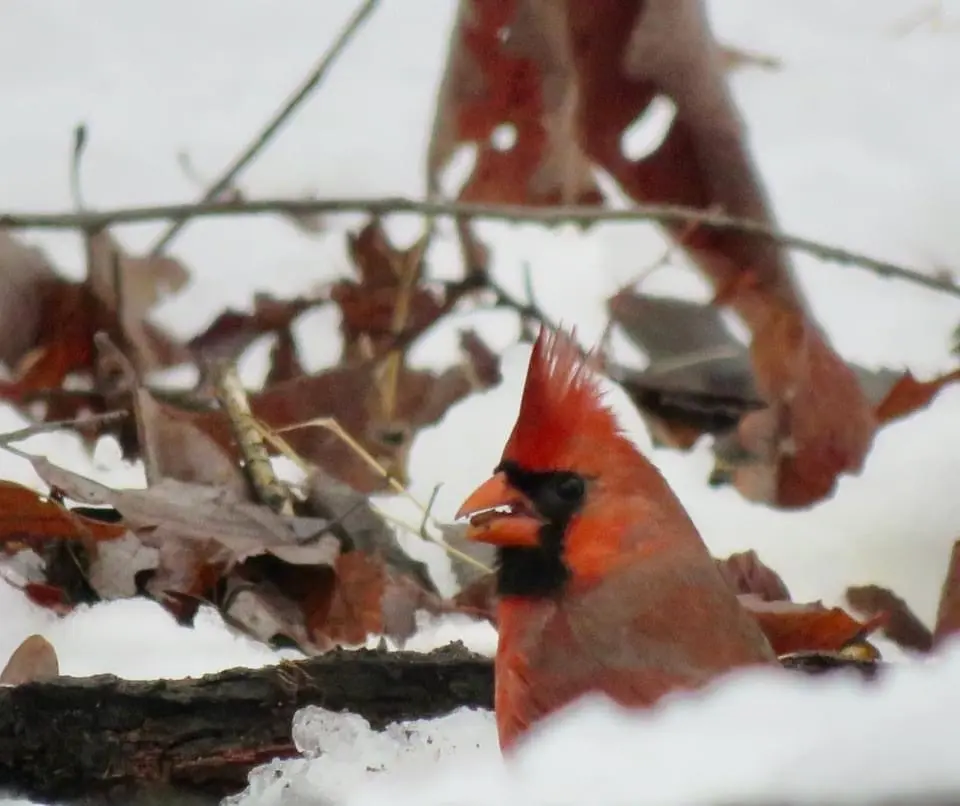
A gray January morning, fresh snow on the fence, and then a flash of red at the feeder. Few backyard sights stop people at the kitchen window quite like a male northern cardinal in winter.
That color can seem too bright for the season, and your eyes aren’t playing tricks on you. Thanks to an odd detail of how cardinals grow their feathers, the males really do reach their reddest around midwinter.
Why Cardinals Get Redder as Winter Goes On
Northern cardinals (Cardinalis cardinalis) don’t migrate, and they don’t molt into a dull winter plumage, so they stay on show in snowy yards all season. They replace their feathers in late summer and early fall, after nesting is over and food is plentiful.
A freshly molted male still isn’t at his brightest, though. Many of his new feathers, especially on the neck and back, have gray tips. Those tips slowly wear away through fall and winter, showing more and more red until he peaks around midwinter, ahead of the spring breeding season.
The same molt explains a sight that puzzles people every fall: the scruffy cardinal. Molting birds commonly show patches of dark, exposed skin, and some drop their head feathers all at once and go briefly bald. It’s an odd look, but in late summer and fall it’s a normal part of growing a new set of feathers.
The Red Comes From What They Eat
A cardinal’s color starts with its food. The red comes from carotenoids, pigments that occur naturally in foods such as red and purple fruits. Cardinals eat mainly seeds and fruit, including dogwood, wild grape, mulberry, hackberry, blackberry and sumac, and they add insects such as beetles, crickets and cicadas. Nestlings are fed mostly insects.
Redder doesn’t always mean healthier. One study found that in rural areas, brighter males tended to mate earlier and nest in better habitat. A 2010 study found the opposite in cities, where brighter birds were in poorer condition and raised fewer young. The authors suggested non-native honeysuckle may be part of the reason, because its berries are high in carotenoids but very low in fats and proteins compared with native fruits like dogwood.
How to Tell Males, Females and Young Birds
Both sexes wear a pointed crest, which they can raise when agitated or lower until it barely shows while resting.
- Males are a saturated red all over, with a black face.
- Females are a warm brown with red accents, and that same sharp crest.
- Young birds have a black bill at first, which helps separate them from adults.
- Size runs about 8 to 9 inches long, with a wingspan of 9 to 12 inches.
- Sounds include a whistled song often written as “what-cheer, cheer, cheer” and a sharp, metallic chip note. Listen for that chip to find a bird hiding in a thicket.
Yes, the Females Sing Too
Only a few female North American songbirds sing, and the female cardinal is one of them. She often sings from the nest, which may tell the male when to bring food. A mated pair shares song phrases, though her song may be a little longer and more complex than his. Early in the breeding season, you may also catch a male feeding his mate.
Both sexes share a habit that baffles homeowners: attacking their own reflection in a window, car mirror or shiny bumper. It happens most often in spring and early summer, when cardinals are intent on driving intruders out of their territory. Birds can keep it up for hours, but the attacks should end within a few weeks as their aggressive hormones subside.
What Cardinals Do All Winter
In the breeding season, cardinals usually travel in pairs. In fall and winter they can gather in flocks of a dozen to several dozen birds, and they sometimes forage with dark-eyed juncos, white-throated sparrows, tufted titmice and goldfinches. There’s a pecking order at mealtime, with young birds giving way to adults and females tending to give way to males. Pairs may stay together through winter, though up to 20 percent split up by the next season.
Their short, round wings make them somewhat reluctant fliers, so you’ll usually see them making short trips between thickets. Their range has been extending north for decades and now reaches southeastern Canada, helped along by the growth of towns and suburbs and possibly by feeders stocked with sunflower seeds. Seven states claim them as their state bird: Illinois, Indiana, Kentucky, North Carolina, Ohio, Virginia and West Virginia.
How to Bring Cardinals to Your Yard
Cardinals are abundant across eastern and central North America, and if you live within their range, they’re among the easier birds to attract.
- Offer sunflower seed. Nearly any feeder can work, and black oil sunflower is a particular favorite. Our guide to feeding birds in winter covers the basics of getting started.
- Keep it clean. Cardinals in winter flocks may share a feeder with many other birds, so a simple cleaning routine is worth keeping up.
- Leave some undergrowth. Cardinals favor dense, shrubby cover, and they tuck their nests 1 to 15 feet up in thick foliage or vine tangles.
- Plant native fruit. Native dogwoods and blackberries offer food that cardinals already seek out. Your local extension office can tell you what’s native to your area and whether a plant is safe around pets.
So the next time a cardinal lands at your feeder against the snow, take a second look. That red took months of good meals and slow wear to reach its peak, and midwinter is the moment it’s been building toward.
Sources: Cornell Lab of Ornithology, Northern Cardinal guide; Cornell Lab, Are Cardinals Redder in Winter?; National Audubon Society, Northern Cardinal.