You step outside with your coffee on the first hard-frost morning of the year, and the birdbath has turned into a solid disc of ice with a single oak leaf frozen in the middle. Your first thought might be to run out with a kettle. Your second might be to wonder whether the birds are going to be all right.
They probably will be. But a little open water can still bring welcome visitors to your yard in the coldest months, as long as you offer it the safe way. A few well-meaning fixes can do real harm, so they’re worth knowing about before the first deep freeze.
Do Birds Really Need a Thawed Birdbath?
Here’s the reassuring part. The Cornell Lab of Ornithology says that keeping a birdbath ice-free in winter is not critical. Birds have several ways of conserving water, and they can usually get what they need from snow or dripping icicles.
Open water is still a real gift, though. The National Wildlife Federation points out that melting frozen water costs birds precious calories and body heat, and that yards with fresh liquid water tend to draw more birds in winter. Think of it as a bonus you can offer when it suits you, not a duty you’ll feel guilty about missing.
Where you live matters too. If your winters rarely dip below freezing, as along the Gulf Coast or in the low deserts of the Southwest, you may only need to keep the water fresh. A freeze with no snow on the ground is when a dish of liquid water is likely to stand out most.
Three Easy Ways to Keep Water Available
You can spend almost nothing or buy dedicated equipment. All of these work, so pick the one you will actually keep up with:
- The daily bowl. This is the simplest method Cornell suggests. Set out a plastic bowl at the same time each day, and bring it in when ice forms.
- Swap-out saucers. The National Wildlife Federation suggests keeping several heavy-duty plant saucers that ice will not crack, then replacing the frozen one with a fresh one each morning.
- A heater. You can buy a birdbath with a built-in, thermostatically controlled heater, or add an immersion heater to one you already own. Both need an outlet nearby. Solar heaters work too, but Penn State Extension notes they do well in sun and not when it is cloudy or overcast.
What Never Goes in the Water
Each of these can seem like a clever way to stop ice from forming. None of them is safe:
- Antifreeze. Cornell is blunt on this one: it is poisonous to all animals, including birds.
- Glycerin. It can saturate and mat feathers, which leaves a bird open to hypothermia.
- Salt. The U.S. Fish and Wildlife Service warns that salt can be toxic to birds, sometimes causing death in less than an hour. Affected birds may react slowly and lose the ability to perch or fly.
Plain, clean water is the only thing to put in the bath. For the food side of cold-weather care, see our beginner’s guide to feeding birds in winter.
Set Up the Bath for Freezing Weather
Before the coldest stretch arrives, take a look at what you already have. Audubon advises against ceramic baths because they can crack in the cold, and Cornell notes that concrete may crack too once temperatures drop below freezing. The National Wildlife Federation recommends storing or covering concrete baths for the winter. A plastic bath is the sturdier choice.
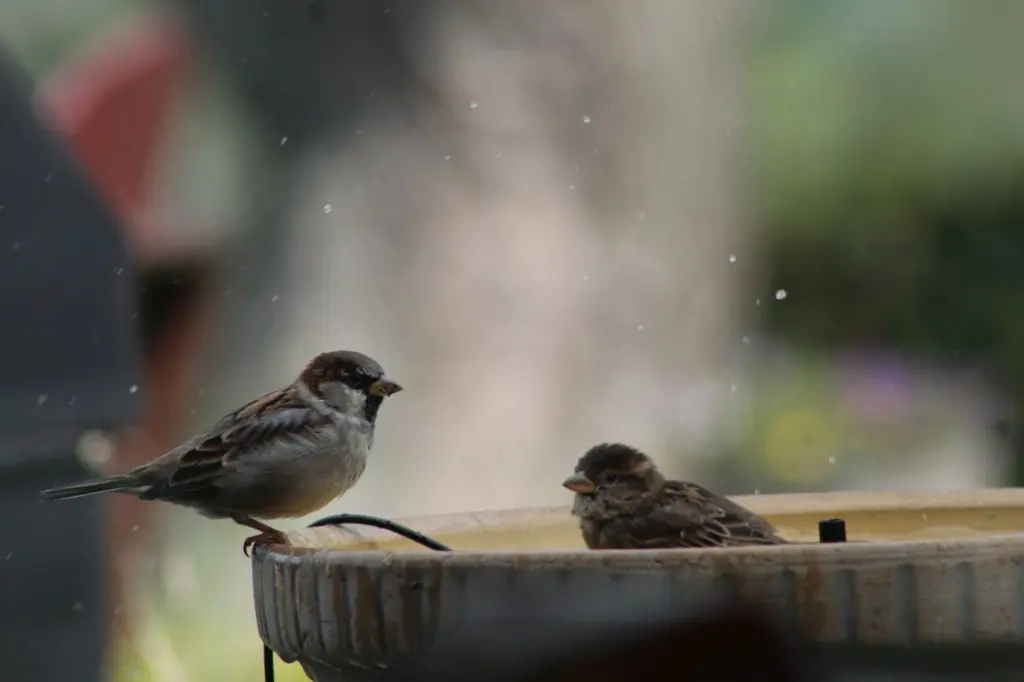
Depth matters in any season. Cornell recommends water no deeper than 1 inch at the edges, sloping to a maximum of 2 inches in the middle. Arrange a few stones or branches in the water so birds can stand on them and drink without getting wet, which Cornell says is especially important in freezing weather.
If you use a heater, plug it into a ground-fault interrupted circuit to eliminate the chance of electric shock, and check that cords and outlets are sheltered from snow and ice. Most newer heaters turn off if the bath dries up, but check your model before you rely on that.
Where to Put It and How to Keep It Clean
A little thought about placement and upkeep goes a long way:
- Choose a sunny spot. In winter, sun helps keep the water liquid and makes the bath easier for birds to see.
- Keep shrubs close, but not too close. Penn State Extension suggests placing a bath near shrubs or low branches so birds can escape from hawks. Ground-level baths are the exception if cats are around. Keep those 10 to 15 feet from the nearest hiding spot, so birds can see trouble coming.
- Stay out from under the feeders. Falling seed and droppings will foul the water quickly.
- Stay on top of refills and cleaning. Water evaporates fast in dry winter air, so expect frequent top-ups. Change the water every day or two and scrub the bath regularly with a stiff brush. Penn State recommends mild soap and a weekly scrub.
Looking for more small changes that help through the cold months? Our wildlife gardening tips are a good place to start.
You don’t need any fancy gear to help out this winter. A plastic bowl set out with your morning coffee is plenty, and you may just get a front-row seat when a chickadee or a bluebird stops in for a drink.
Sources: Cornell Lab of Ornithology, All About Birds, U.S. Fish and Wildlife Service, Penn State Extension.