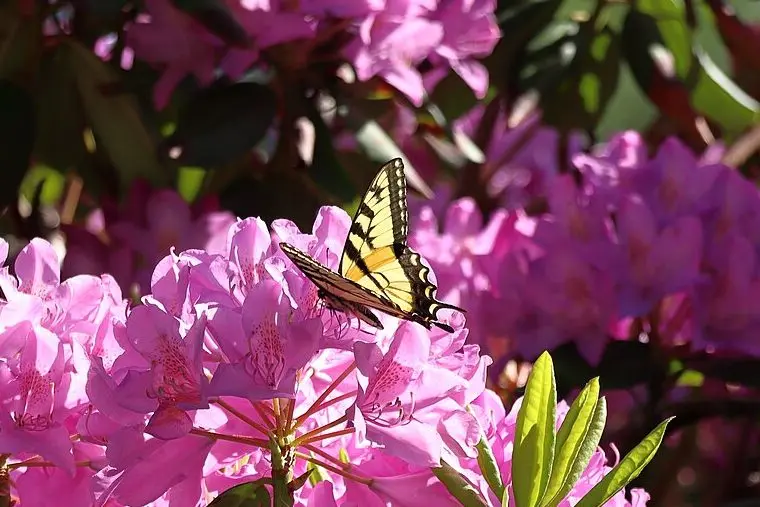
You look up from the garden and a large yellow butterfly is sailing past the top of a tree. A moment later it drifts down to a patch of flowers, and you can finally see the bold black stripes across its wings. For many people east of the Rockies, that is a first meeting with the eastern tiger swallowtail.
It is one of those butterflies that seems easy to know at a glance. Spend a little more time with it, though, and you find black females, caterpillars with fake eyes and a surprisingly smelly defense.
How to recognize an eastern tiger swallowtail
The eastern tiger swallowtail, Papilio glaucus, belongs to the swallowtail family. Males are yellow with black tiger stripes and a wide black border around the edges of the wings. The wingspan runs from about 2½ to 4½ inches, so it is hard to overlook when it passes close by.
The Missouri Department of Conservation calls it the state’s only swallowtail with yellow and black stripes. If you live elsewhere, it is worth checking a regional guide, since the butterflies you can confuse it with depend on where you are.
Its range is wide. Animal Diversity Web describes it from Alaska and Canada down to the southern United States, east of the Rocky Mountains. It turns up almost anywhere deciduous woods grow, including towns and cities, and it is especially common along streams, rivers and wooded swamps.
Not every female is yellow
Here is where identification gets interesting. Some females look much like the males, while others are black with darker black stripes. Animal Diversity Web adds that you can also find a range of patterns between those two extremes. Both female forms have blue scales on the top of the hindwings.
Why be black? According to the Missouri Department of Conservation, dark females are found only where the tiger swallowtail’s range overlaps that of the pipevine swallowtail, a look-alike with acrid body juices that predators find unpalatable. Researchers have learned that males prefer yellow females, while dark females seem to survive longer, which gives them time to lay more eggs. So each color comes with its own advantage.
Caterpillars with a few tricks
The caterpillars are just as memorable as the adults. They are bright green, with two large eyespots on the thorax just behind the head. Those markings give them an oddly alert face, even though they are not real eyes.
If a caterpillar is disturbed, it rears back and pushes out an osmeterium. This is a stinky, orange, forked gland that helps deter predators. Finding one can be startling, but it is simply a small animal trying to protect itself, so it is best to leave it in peace.
The trees and plants caterpillars eat
Tiger swallowtail caterpillars feed on the leaves of many woody plants. The two sources we read list these among their food plants:
- Tulip tree: named by both sources.
- Cherries: black cherry is the example the Missouri Department of Conservation points to.
- Willows and ashes: both appear on both lists.
- Other trees: poplars, birch, basswood, maple, magnolia, apple and wafer ash, also called hop tree, are also listed.
Not all of these will suit your region or your yard. Before you plant a tree for butterflies, check which ones are native where you live and whether the spot has enough room. Our native plants section is a good place to start.
What adults do all day
Adults drink nectar from a variety of flowers, and they also help pollinate them. Both males and females are known as high fliers, so look up as well as down.
You may also spot one on damp ground. Males are more likely than females to “puddle,” which means sipping liquid and salts from puddles or wet soil. They pass minerals to females during mating, which helps the females lay more eggs and improves the young’s chances of survival.
In Missouri, adults fly from late March into October, and Animal Diversity Web says the last adults stay around into mid-autumn. Those dates can shift depending on where you live, so treat them as a rough guide rather than a calendar for your own state.
Making your yard a better stop
You cannot count on any particular butterfly showing up, but you can make your yard more useful to the ones passing through:
- Offer flowers for as long as you can: adults fly over a long season, so blooms from spring into fall give them more chances to feed.
- Keep a damp spot: a patch of wet soil gives males a place to puddle.
- Keep the host trees you have: a cherry or tulip tree already on your property may be feeding caterpillars you have never noticed.
- Go easy on insecticides: a spray aimed at pests can also harm butterflies and caterpillars.
For more ideas, take a look at our butterflies and pollinators guides, or follow another familiar butterfly in our monarch article.
Here is a bit of trivia to share the next time one floats past. Animal Diversity Web says the tiger swallowtail was the first American insect pictured in Europe, from a drawing sent to England from Sir Walter Raleigh’s third expedition to Virginia. It has been catching people’s attention for a very long time.
Sources: Missouri Department of Conservation: Eastern Tiger Swallowtail; Animal Diversity Web: Papilio glaucus.