You turn on the porch light on a warm summer night and notice a small, lumpy shape sitting just below it, perfectly still. A moth drops to the ground, and suddenly it’s gone. That bit of quiet pest control is a regular night’s work for an American toad.
The American toad (Anaxyrus americanus) ranges from Canada through much of the eastern United States. It needs a semi-permanent pond for breeding and dense vegetation to live in, and it’s right at home in backyards, parks, and gardens.
How to identify one
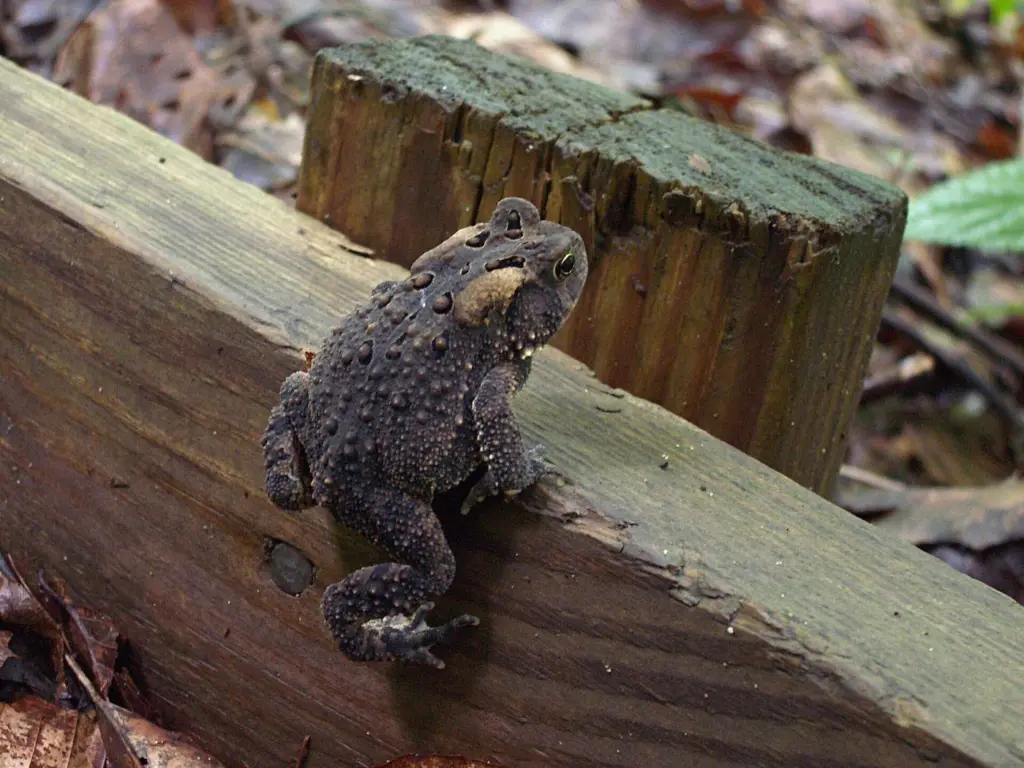
American toads are chunky and warty. They can be gray, greenish gray, brown, or reddish brown, and some have a light stripe down the back. Their color can even shift with temperature, humidity, and stress. Adults are usually 2 to 3½ inches long, and females are larger than males.
Two features help most with identification:
- The glands behind the eyes: look for a large parotoid gland behind each eye.
- The spots on the back: blackish spots usually contain just one or two warts each.
During breeding season, you can also tell the sexes apart, since males have dark throats.
What a toad does all night
During the day, toads hide under rocks, logs, leaf piles, boards, wood piles, and porches, or tuck themselves into loose soil. They become active at dusk. When it’s time to hibernate, they dig in backward.
Their diet is mostly insects and earthworms, and they catch prey with a quick, sticky tongue. On summer nights, they often gather under outdoor lights to pick off the insects drawn there.
Here’s one more odd fact: toads don’t drink. They absorb water through their skin. They also shed that skin from time to time, then gulp it down.
A spring chorus and thousands of eggs
If you’ve heard a long, high trill coming from a pond on a spring night, it may well be a male American toad. Each trill lasts several seconds, sometimes up to half a minute, and his throat balloons out as he calls.
Timing varies by location. In Missouri, for example, males start calling from mid-March to early April, with a peak from late April through May. They breed in temporary pools, ponds, and slow, shallow streams.
Females lay thousands of eggs in long, double strands. The eggs hatch in about a week, into tiny black tadpoles that swarm in the shallows. About 40 to 70 days later, they turn into toadlets only about half an inch long and head onto land.
Most never get that far. Animal Diversity Web says the majority die before they become toadlets. Predators of toads include water bugs, fish, grackles, and raccoons. The survivors reach maturity in 2 to 3 years. Missouri’s conservation department puts a typical lifespan at about 4 to 5 years, though some have lived more than 10 in the wild.
Warts, toxins, and curious dogs
First, the myth: toads don’t cause warts. The Missouri Department of Conservation is clear about that, and it calls them harmless to people.
The toxin is real, though. A threatened toad’s skin secretes a milky poison that irritates a predator’s mouth. Animal Diversity Web says it’s harmful if swallowed or if it gets in the eyes, so washing your hands after handling a toad is a sensible habit. Toads have other tricks too, such as puffing up their bodies. Not everything is put off: hognose snakes specialize in eating toads, and garter snakes are immune to the poison. You can read more about garter snakes in our guide to the eastern garter snake.
Dogs are the bigger concern, since some can’t resist picking up a toad. Pet Poison Helpline includes the American toad among the poisonous species. Watch for:
- Mouth signs: drooling, frothing, red and painful gums, or pawing at the mouth.
- Stomach trouble: vomiting or diarrhea.
- Nervous system signs: tremors or seizures.
If you think your pet has bitten a toad, call your veterinarian or Pet Poison Helpline right away. VCA Animal Hospitals says that immediately flushing the mouth with large amounts of running water reduces how much poison is absorbed, and it also advises rinsing the face and eyes. Dogs typically recover, and supervising your pets outdoors can prevent most of this.
Making room for toads
Toads don’t need much, and many of the things they like are easy to leave in place:
- Daytime shelter: a pile of leaves, a log, a flat stone, or a board.
- Dense planting: thick vegetation gives them the cover they need.
- Loose soil: somewhere they can burrow in.
- Nearby water: if you’ve got a pond or there’s one close by, you might hear that trill come spring.
Every yard is different, and one may or may not move in. Still, a garden with a few messy corners stands a better chance. For more ideas, see our wildlife gardening tips or meet more of your neighbors in our animal fact files.
Sources: Missouri Department of Conservation: American Toad; Animal Diversity Web: Anaxyrus americanus; Pet Poison Helpline: My Dog Bit a Toad; VCA Animal Hospitals: Toad Poisoning in Dogs.