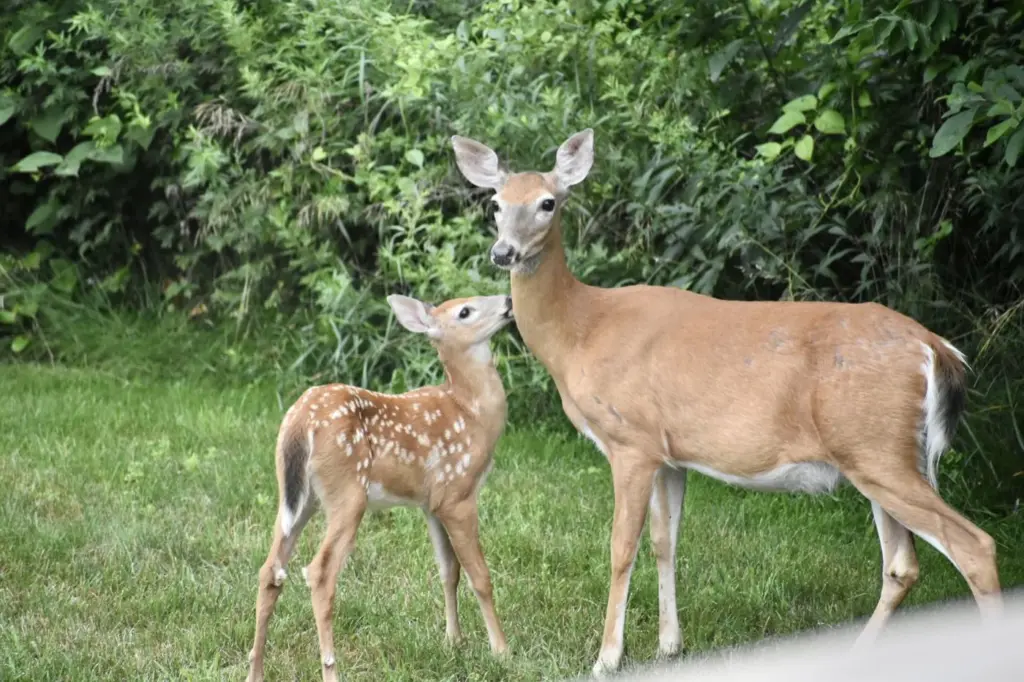
You glance out the kitchen window around dusk and there she is: a doe at the edge of the lawn, ears turning, with a spotted fawn a few steps behind her. Then a car door slams, a white tail goes up, and the two of them are gone.
White-tailed deer (Odocoileus virginianus) live across most of southern Canada and nearly all of the mainland United States, and their range continues through Central America to Bolivia. If you live near woods or farm fields, there’s a fair chance they pass through your neighborhood.
How to recognize a white-tail
The coat changes with the seasons. In summer, a white-tailed deer is reddish brown to tan. By winter, it has turned grayish. The belly, chin, throat, and underside of the tail stay white all year.
That tail gives the deer its name. When one runs from danger, it holds the tail high and shows the white underside like a flag.
An adult is about 6 feet long, including a tail of roughly 8 inches. Missouri’s conservation department lists females at about 110 to 145 pounds and males at about 155 to 195 pounds. If you never see the deer themselves, look for their tracks in mud or snow. Each one is roughly heart-shaped and 2½ to 4 inches long.
Why dawn and dusk are your best chance
White-tails are most active around dawn and dusk. They favor the transition zones where woodland edges meet clearings and fields, which is one reason a yard next to a patch of trees can get so many visits.
They’re herbivores, and the list is long: leaves, twigs, fruits, nuts, grasses, and crops, with the occasional fungus, moss, or lichen.
A few other habits are worth knowing:
- They stay local: home ranges are often a square kilometer or less, and deer don’t migrate. In heavy snow, they gather together, a habit called yarding up.
- They trust their noses: white-tails have good eyesight and hearing, but they rely mainly on smell.
- They can really move: a running deer can reach about 30 miles per hour, and they’re good swimmers as well.
- They make some noise: whistles and snorts are their most common sounds.
Antlers grow new every year
Antlers normally grow only on males, and they’re formed and shed each year. In Missouri, growth usually starts in April and finishes in August, and most antlers drop in February and March. While they’re growing, antlers are covered in a soft layer known as velvet.
Bucks also leave signs behind. Rubs and scrapes are both marks they make, so finding one is a good clue that a buck has been through.
Why fawns spend so much time alone
Missouri’s mating season peaks in mid-November, and pregnancy lasts about 200 days, so most fawns there arrive in late May or early June. Twins are usual, and they weigh about 4 to 7 pounds each. Timing can differ where you live.
Fawns can walk at birth, yet their mothers still hide them in dense vegetation, sometimes for around four hours at a stretch. According to Maine’s wildlife department, a doe returns two or three times a day to nurse. The rest of the time, the fawn lies flat with its neck stretched out, protected by its camouflaged coat and its lack of scent.
Fawns start following their mothers at about 4 weeks old. They nurse for 8 to 10 weeks and lose their spots at 3 to 4 months.
If you find a fawn by itself
Most fawns found alone aren’t orphans. Wisconsin’s DNR and Maine’s wildlife department give similar advice:
- Leave it where it is: don’t touch it, and never try to feed it.
- Clear out: a doe won’t come back while people or dogs are nearby, so keep your distance, keep children back, and bring pets inside.
- Don’t keep checking: repeat visits can draw predators to the fawn.
- Don’t panic over a little wandering: Wisconsin’s DNR says a fawn may stand, cry out, or move around.
- Call for help only if it’s hurt or sick: your state wildlife agency or a licensed wildlife rehabilitator can tell you what to do next.
Please don’t try to raise one yourself. Maine’s wildlife department warns that captive-raised fawns have high mortality.
Deer, gardens, and the bigger picture
Deer shape the places they live. Browsing can encourage denser plant growth, but where there are too many deer, they can damage plants and limit forest regeneration. They also damage crops and landscaping and are involved in vehicle collisions. And they’re part of the food web, feeding coyotes, bobcats, and scavengers.
What holds up in a garden varies by region, so your local extension office is a good place to ask which native plants suit your area.
There’s also chronic wasting disease, a fatal, contagious prion disease of deer. Signs can take one to two years to appear, and it spreads through infected deer and carcasses. Your state wildlife agency can tell you if it’s a concern near you.
If you enjoy watching deer, the quiet edges of the day are the time to try. For more of the animals that share our yards and woods, browse our animal fact files.
Sources: Missouri Department of Conservation: White-tailed Deer; Animal Diversity Web: Odocoileus virginianus; Maine Department of Inland Fisheries and Wildlife: Deer Fawns; Wisconsin DNR: Orphaned Deer.