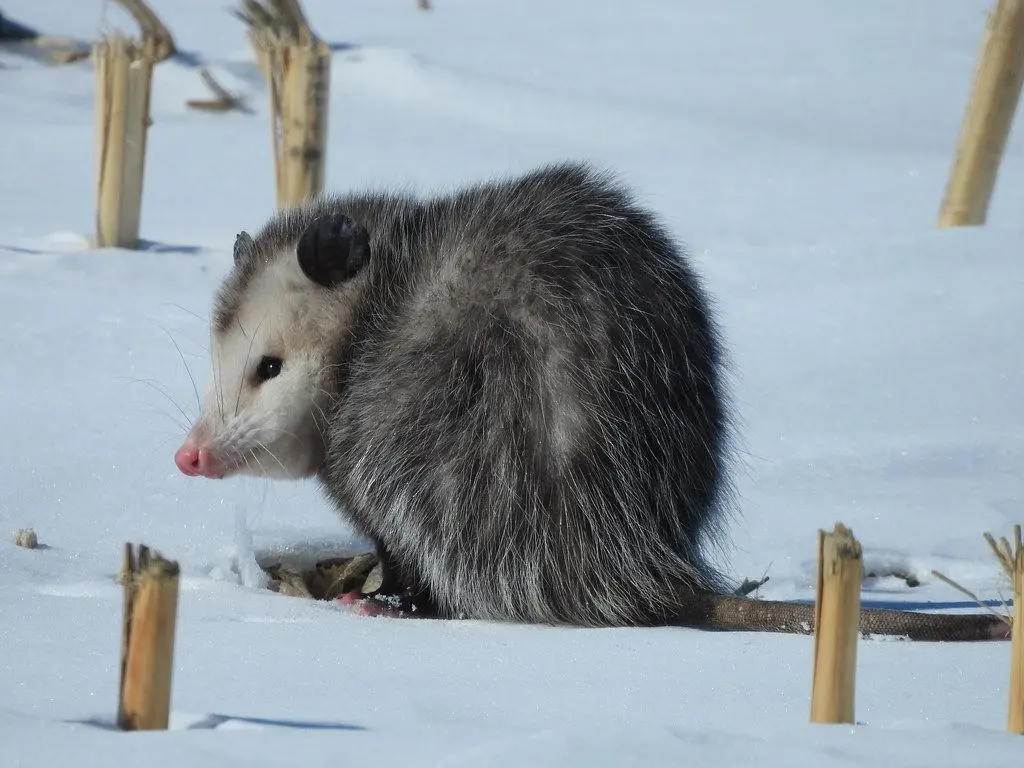
If you’ve ever caught a pale, pointy-faced animal in your headlights at night, you’ve met the Virginia opossum. It’s one of the most misunderstood animals in the backyard. People call it a giant rat or a pest, and it’s neither. It’s North America’s only marsupial, and having one around is a quiet gift to your garden.
A Pouch-Carrying Neighbor
The Virginia opossum (Didelphis virginiana) is the only marsupial found north of Mexico. Like kangaroos and koalas, a mother opossum carries her young in a pouch. The babies are born after a pregnancy of only about two weeks. At birth they’re roughly the size of a honeybee, and they crawl straight into the pouch to nurse.
They stay in the pouch for about two months. Then they spend a few more weeks riding on their mother’s back, clinging to her fur as she forages. A litter often numbers eight or more, though not every baby survives.
Surprising Opossum Facts
- 50 teeth. No other North American land mammal has more. That toothy hiss is mostly bluff.
- Thumbs on their feet. Each hind foot has a clawless, opposable toe that works like a thumb and helps them grip branches.
- A tail that grabs. The prehensile tail helps with balance and with carrying bundles of leaves for nesting. Young opossums can hang from it briefly, but adults don’t sleep hanging upside down. That one’s a myth.
- Resistance to snake venom. Opossums are partly resistant to the venom of rattlesnakes and copperheads, and researchers have studied the protein responsible.
- Rarely rabid. Rabies is very uncommon in opossums. One likely reason is their relatively low body temperature, which makes them a poor host for the virus.
- Short lives. In the wild, most opossums live only one to two years.
What “Playing Possum” Really Means
An opossum’s first defense is to hiss, drool and show off all those teeth. If that fails, a badly frightened opossum may collapse into an apparent death. It goes limp, its lips pull back, and it releases a foul-smelling fluid that makes it seem like spoiled carrion.
This isn’t a clever act. It’s an involuntary response, a bit like fainting. The opossum can stay that way for minutes or even a few hours before it slowly comes back and wanders off. If you find a “dead” opossum with no visible injuries, give it space and check back later.
The Backyard Cleanup Crew
Opossums eat almost anything. They take beetles, slugs, snails, crickets, fallen fruit, mice and carrion. They are nomadic, moving from den to den rather than settling in one spot. That means a visiting opossum usually passes through, eating garden pests and tidying up dropped fruit along the way.
You may have heard that a single opossum eats thousands of ticks each season. That figure came from a lab study, and later research on wild opossums found ticks make up only a small part of their diet. Opossums do groom off ticks, but they’re not the tick vacuums the internet claims. Their real value is as all-purpose recyclers.
Living Alongside Opossums
Opossums rarely cause trouble, and a few simple habits keep it that way:
- Keep trash cans tightly lidded and bring pet food indoors at night.
- Don’t feed them on purpose. They’ll find plenty on their own.
- Close gaps under decks and sheds if you’d rather they den elsewhere, but wait until no one is home inside.
- Leave a brush pile or leaf litter in a back corner. It shelters the insects and snails opossums eat.
- If you find a mother opossum killed on the road, check her pouch carefully, or call a local wildlife rehabilitator. Her babies may still be alive.
The next time a shuffling, gray shape crosses your yard after dark, take a moment to watch. You’re looking at an ancient lineage of pouched mammals that has quietly made itself at home in our neighborhoods.