You are weeding on a warm afternoon when a small striped insect stops in midair right in front of you. It hangs there, darts a few inches to the side and hangs there again. A moment later it lands on your arm, and your first thought is probably “bee.”
Take a closer look, because it is most likely a hover fly. These little insects look like they could sting, but they cannot. They are also among the more useful insects you can have around a vegetable or flower garden.
A fly dressed up as a bee
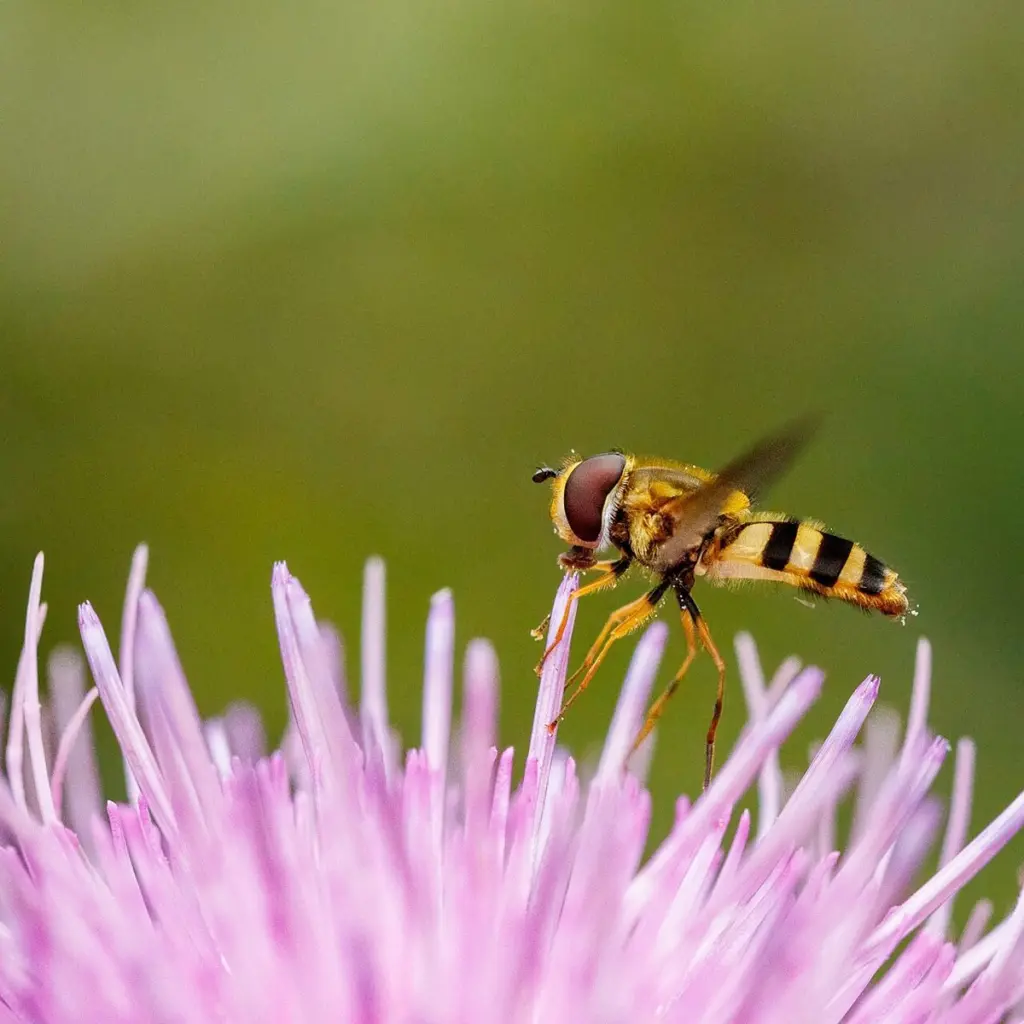
Hover flies belong to the fly family Syrphidae, and you may also hear them called flower flies or syrphid flies. University of Illinois Extension says they range from about ¼ to ¾ of an inch long, with yellow, orange and black markings.
That coloring is a disguise. Extension entomologists describe it as mimicry: hover flies copy the look of bees and wasps, presumably to gain some protection from their own predators. It clearly works on people too, since most of us back away from anything small with yellow and black stripes.
The important part for gardeners is simple. Hover flies do not have stingers. NC State Extension describes them as incapable of stinging and totally harmless, and they do not bite either.
How to tell a hover fly from a bee
You do not need a microscope. A few quick checks will usually settle it:
- Wings: hover flies have one pair of wings, for two in total. Bees and wasps have two pairs. Illinois Extension offers a handy rhyme: “two wings fun, four wings run.”
- Antennae: hover flies have very small, short antennae. Bees and wasps have longer antennae, often with an elbow-like bend.
- Eyes: hover fly eyes are often larger and may look as if they wrap around the head.
- Flight: hover flies spend much of their time hanging in one place, while bees and wasps tend to move with more direction.
If a small insect does sting you, it was not a hover fly. One of their other nicknames causes a lot of confusion here, because people often call them “sweat bees.” Illinois Extension says they may land on us for moisture and salt from our sweat, but a sting from a small insect on sweaty skin is most likely a true sweat bee. Those are real bees, and you can meet some of them in our guide to native bees.
What the adults are doing on your flowers
Adult hover flies feed on nectar and pollen, and the University of Delaware’s crop update notes that they also take aphid honeydew. Moving from bloom to bloom makes them pollinators, and Illinois Extension calls them important ones.
They are also early risers in the gardening year. The same Delaware article describes them as one of the earlier natural enemies of pests to appear in spring, and as typically more effective than other predatory insects in cool weather.
The larvae are the aphid eaters
The adults get the attention, but the young do the pest control. Females lay their whitish eggs, often one at a time, on plants in or near aphid colonies. After about three days, the eggs hatch into legless, maggot-like larvae.
A hover fly larva will not win any beauty contests. It has a tapered body, and depending on the species and its recent meals, it can be creamy white, green, brown or pinkish. It is easy to miss, and some are camouflaged against the plant. It uses hooked mouthparts to grab prey and suck out the juices.
Illinois Extension says a single larva can eat 20 to 30 aphids a day and up to 400 during its development, though the Delaware article notes that this varies by species. Larvae also eat other small, soft-bodied insects, including thrips, mealybugs and scale. They feed for seven to ten days before pupating, and adults emerge about ten days later.
So the next time you find a small, legless maggot among your aphids, pause before squashing it. Not every maggot in the garden is a hover fly, but this one may be doing your pest control for free.
Not every species is a helper
As with most large insect groups, there are exceptions. Illinois Extension notes that a few hover fly species are considered pests, including the Narcissus bulb fly. Most gardeners will still count the family as a welcome sight.
How to welcome hover flies
There is no way to promise they will settle in, but a few simple habits can make your garden more inviting:
- Grow small flowers: Illinois Extension names sweet alyssum, coriander and dill among the plants they visit, and other small-flowered herbs work too.
- Let a few herbs bloom: a bolting dill or coriander plant you were about to pull may be useful to them.
- Wait before spraying aphids: a spray that kills aphids can also kill the larvae feeding on them, so check for helpers first.
- Plant for more than one season: flowers from early spring onward give adults something to feed on whenever they are out.
You will find more ideas in our wildlife gardening tips and pollinator guides.
Next time a striped insect hangs in the air in front of your face, you can stay put and count its wings. Chances are it is just a harmless little fly having a look around.
Sources: University of Illinois Extension: Syrphid (Hover) Flies; University of Illinois Extension: Hover Flies May Look Like Bees but Are Beneficial Flies; NC State Extension: Hover Fly; University of Delaware Weekly Crop Update: Syrphid Flies.