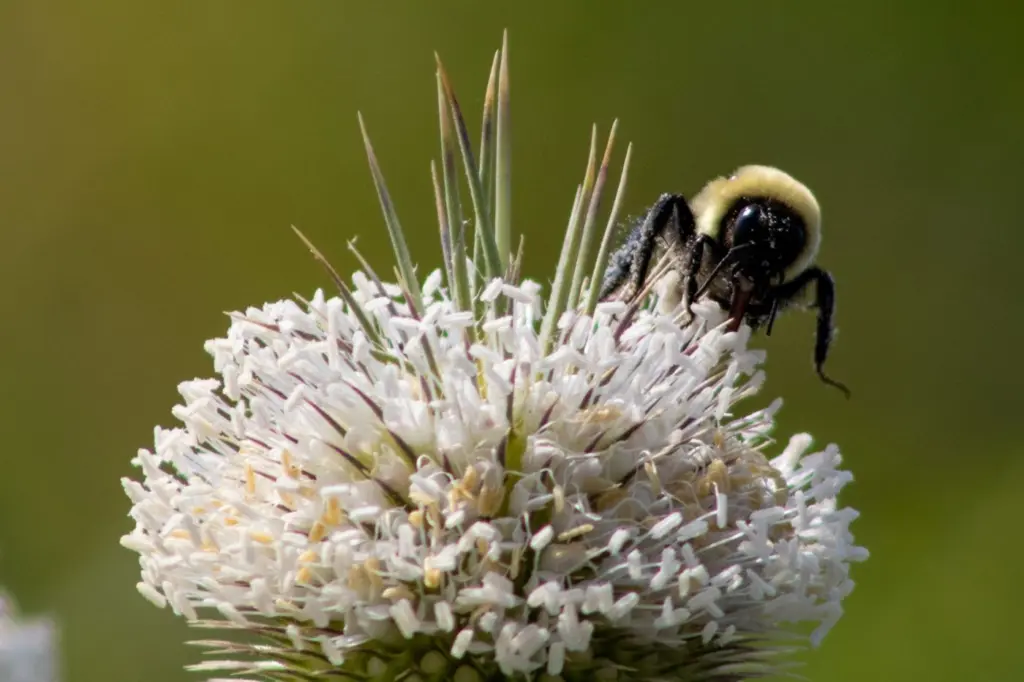
Stand beside a flowering shrub in midsummer and you’ll probably hear them before you see them: a low, steady hum, then a round, fuzzy bee backing out of a blossom with pollen packed on its legs. If you’ve ever found one asleep, clinging to the underside of a leaf, you already know how hard they are to dislike.
Bumble bees belong to the genus Bombus, which includes many species. They’re large, about ½ to 1 inch long, and they do important work in gardens and wild places alike.
Bumble bee or carpenter bee?
Bumble bees are big, fuzzy, and black and yellow, sometimes with orange. Their closest lookalikes in many yards are carpenter bees. The easy way to separate them is to check the abdomen:
- Bumble bee: fuzzy.
- Carpenter bee: shiny, hairless, and black.
Females also have pollen baskets on their legs, which is where you’ll see those packed loads. Some flies and beetles mimic bumble bees, and so does the snowberry clearwing, a moth.
That famous buzz comes from vibrations of the wing muscles inside the bee’s body.
The trick honey bees can’t do
Some flowers hold their pollen tightly, and a visitor can’t just brush it off. Bumble bees solve this with buzz pollination, shaking the pollen loose from the anthers. According to the Missouri Department of Conservation, honey bees can’t do this.
For gardeners, this is good news. Utah State University Extension notes that buzz pollination is used on tomatoes, eggplants, potatoes, and blueberries. In the wild, plants such as southern wild senna, partridge pea, and closed gentian need it, and red clover is rarely pollinated by other bees.
While we’re on the subject of flight, you may have heard that bumble bees “defy the laws of physics.” They don’t. The Missouri Department of Conservation explains that the myth is false: they sweep their wings back and forth.
A colony that lasts one season
A bumble bee colony works very differently from a honey bee hive. Here’s the yearly cycle:
- Spring: a queen that survived the winter starts a nest alone. She builds a cell of wax and pollen and incubates her eggs, sitting on them much as a bird would.
- Summer: those young become workers, and the colony grows. It rarely has more than about a hundred workers.
- Late season: new queens and males are produced.
- Winter: the colony dies, and only the young queens survive, hibernating until spring.
Adults drink nectar and feed pollen and honey to their young. Since the colony doesn’t last the winter, it doesn’t stockpile much honey.
Nests are usually below ground, often in former rodent burrows. They can also turn up in grass tussocks, debris or brush piles, and even birdhouses, though rarely in direct sun. Penn State Extension points out why a spring queen matters so much: one queen can be worth several hundred bees over time.
Are they likely to sting you?
Bumble bees can sting, but they aren’t aggressive. They generally do so only if they’re molested or their nest is in danger.
If you find a nest on your property, the Missouri Department of Conservation’s advice is to leave it alone. Keep people and pets clear of it, and remember that it won’t be there forever, since the colony dies when winter comes.
Why they need some help
Many bumble bee species are declining, and the rusty patched bumble bee is federally endangered. A home garden can’t fix all of that, but it can help. Here’s where to start:
- Plan for a long bloom: University of Wisconsin-Madison Extension recommends flowers from early spring through late fall, when queens are preparing for winter.
- Leave some rough spots: Penn State Extension suggests leaving brush piles and undisturbed tall grass.
- Wait on cleanup: University of Illinois Extension advises holding off on cutting plants back until nights are consistently above 50°F. Diseased plant material is an exception, Penn State Master Gardeners note.
- Cut back on pesticides: if you must use one, Penn State Master Gardeners advise choosing the least toxic option, reading the label, and never spraying a blooming plant.
- Choose plants carefully: skip invasive species. Butterfly bush, for one, can be invasive in some places. Our native plants guides are a good place to begin, and it’s worth checking what’s recommended in your state.
If you’d like to go a step further, some states run community science projects, such as the Missouri Bumble Bee Atlas, where your sightings can be useful.
Bumble bees will find what suits them on their own schedule, and every yard is different. Still, a few more flowers and a little less tidying can go a long way. For more on the insects that keep our gardens going, browse our butterflies and pollinators guides.
Sources: Missouri Department of Conservation: Bumblebees; Utah State University Extension: Misconceptions About Bees; University of Wisconsin-Madison Extension: Pollinators; Penn State Extension: Orchard Pollination, Wild Bees; Penn State Master Gardeners: Help Bees; University of Illinois Extension: Delay Spring Garden Cleanup.