It’s barely light out, the house is quiet, and somewhere nearby a bird starts singing: cheer-up, cheerily, cheer-up, cheerily. Audubon notes that the American robin’s song is among the earliest heard at dawn.
Later that morning, you may see one on the lawn, running a few steps, stopping, and cocking its head. The American robin (Turdus migratorius) is about as familiar as North American birds get, and it still has a few surprises.
How to identify a robin
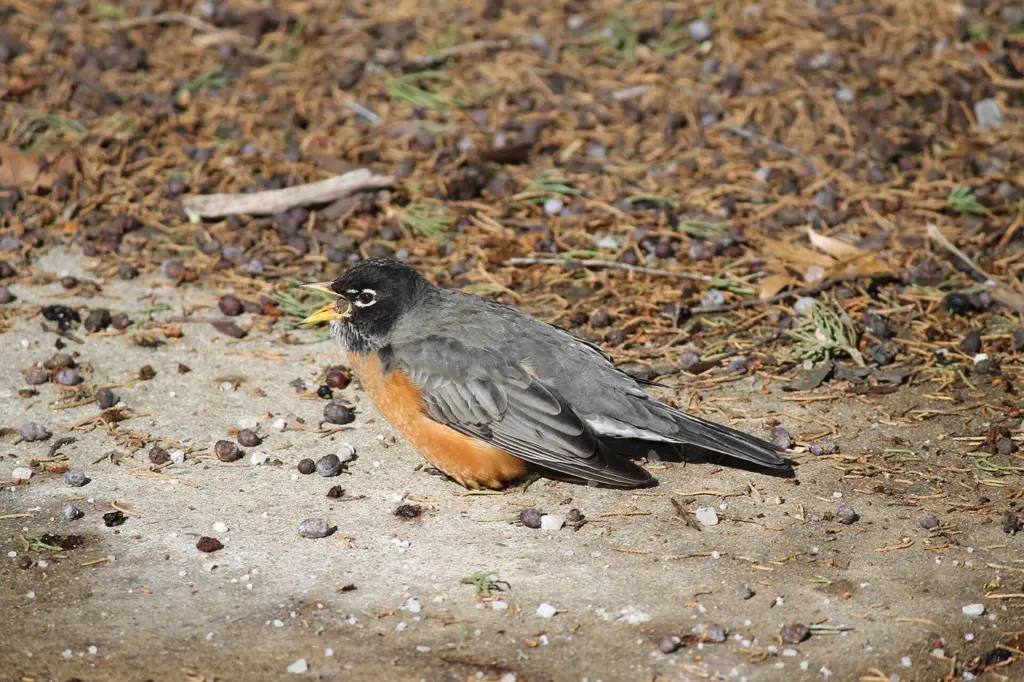
Robins measure about 8 to 11 inches long, with a wingspan of 12 to 16 inches. Look for a grayish-brown back, a blackish head, a split white ring around the eye, and a rusty red chest and belly, with white under the tail. Females are paler than males.
Young birds can throw you off. A juvenile is heavily spotted, so it doesn’t look much like its parents at first glance.
Does a robin really hear worms?
That head tilt looks exactly like listening, and it’s been suggested that robins hear earthworms moving underground. Audubon’s guide says otherwise: robins find earthworms by sight.
Worms are only part of the story, though. Over the year, a robin’s diet shifts quite a bit:
- Early summer: mostly insects, along with earthworms and grubs.
- Nesting season: the young are fed on insects and earthworms.
- Winter: heavily fruit, mainly wild berries.
- Year-round: Audubon says fruit may make up around 60% of the diet.
When they aren’t nesting, robins often forage in flocks, so a lawn with one robin in spring may look very different from a berry tree covered with them in winter.
The “first robin of spring” myth
Seeing a robin in March feels like news from the south. It may not be. Some robins winter as far north as Canada, and they tend to settle in wooded areas with good berry crops. According to Audubon, the “first robin of spring” may be a bird that spent the winter only a few miles away.
In fall and winter, roaming flocks can number in the hundreds, gathering wherever the food is good. So if you see no robins for a while in the cold months, then suddenly find a crowd at a berry shrub, that’s probably why.
From mud cup to fledgling
The male arrives on the nesting grounds first and sings to defend his territory. The female does most of the building. The nest is a cup of grasses, twigs, and debris set on a foundation of mud.
Nests usually sit on a horizontal branch 5 to 25 feet up, but robins also use ledges on houses, barns, and bridges. That’s why you may find one on your porch.
Here’s how a typical nesting attempt goes:
- Eggs: usually 4, and that famous blue.
- Incubation: the female sits for 12 to 14 days.
- Leaving the nest: the young go about 14 to 16 days after hatching.
- After leaving: fledglings still need their parents, and the male may look after them while the female starts another nest.
A pair usually raises 2 broods a season, sometimes 3. Parents defend the nest aggressively, so give a busy porch nest some room if you get dive-bombed on the way to the mailbox. Robins are also protected under the Migratory Bird Treaty Act, so leave active nests in place. The wait is usually only a few weeks.
Robins look out for more than their own nests, too. The Missouri Department of Conservation notes that their warning calls alert other birds.
Helping robins in your yard
You don’t need a feeder to attract robins. They mostly want what they’ve always wanted:
- Ground to forage on: lawns and garden beds where they can run and hunt for worms, grubs, and insects.
- Berries: wild berries matter a great deal, especially in winter. Our native plants guides can help you think about what suits your area.
- Nest sites and mud: trees or sheltered ledges to build on, and some mud for the foundation.
- Fewer pesticides: Audubon points out that robins can give early warning of pesticide overuse. They’re also tied to the history of Rachel Carson’s Silent Spring, the book that made many people think hard about that problem.
Every yard is different, and there’s no promising a robin will pick yours. But they’re abundant and widespread, with Audubon listing a population of about 370 million, so your odds are decent. Next time you see one on the lawn, watch for a while. The run, the pause, and the sudden tug on a worm never quite get old. You’ll find more ideas in our backyard birds guides.
Sources: Missouri Department of Conservation: American Robin; Audubon Guide to North American Birds: American Robin.