Most backyard animals come and go. An eastern box turtle stays. The one crossing your driveway this summer may have been living within a few hundred yards of that spot since before the house was built, and with a little luck it will still be there long after you’ve moved away.
Box turtles are one of the few reptiles many people still meet close to home, especially in the eastern half of the country. They’re also quietly disappearing from a lot of places they used to be common. Knowing a bit about how they live goes a long way toward keeping them around.
A Turtle That Lives on Land
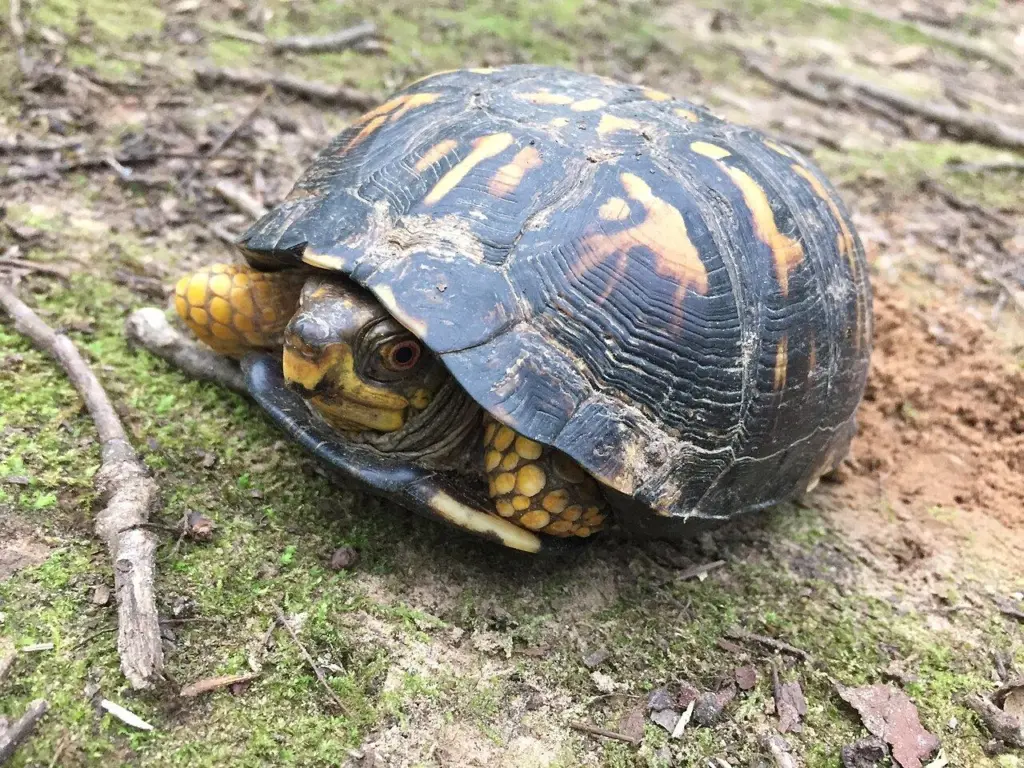
The eastern box turtle (Terrapene carolina carolina) is a land turtle, not a pond turtle. It lives in open woods, woodland edges, meadows and, often, the overgrown corners of suburban yards. It will soak in a puddle or the shallow edge of a stream on a hot day, but it can’t really swim and it doesn’t need a pond to get by.
The name comes from the hinge across the bottom shell. When a box turtle is threatened, it pulls in its head and legs and closes both halves of the lower shell tight against the top one, sealing itself inside like a box. Very few predators can get past that.
Things Worth Knowing About Box Turtles
- They live a very long time. Box turtles commonly live 40 or 50 years in the wild, and a few are believed to have passed 100.
- They stay put. Most adults spend their whole lives in a home range of just a few acres. They know it well, down to the best spots to dig in for winter.
- They eat almost anything. Slugs, earthworms, beetles, berries, fallen fruit and mushrooms are all on the menu, including mushrooms that would poison a person. They also help spread the seeds of plants like mayapple.
- Nest temperature decides sex. Eggs incubated in warmer soil mostly hatch as females, and cooler nests produce mostly males.
- You can often tell males from females by their eyes. Males usually have red or orange eyes. Females tend to have brown or yellowish eyes. Males also have a slightly dented lower shell.
- They grow up slowly. A box turtle may take seven to ten years to start breeding, and a female lays only a handful of eggs each year.
Where They Go in Winter
By late fall, box turtles dig down into loose soil, usually under a layer of fallen leaves or a rotting log, and settle in until spring. They stay there for months, barely breathing, while the leaves above them act like a blanket. This is one of the best reasons to leave some leaf litter in the quieter corners of your yard. A raked-bare garden bed has nowhere for a turtle to tuck in.
When they come back out in spring, often after a warm rain, they head right back to their usual haunts.
Why Every Adult Counts
Box turtles work on a long timeline. Because they mature so late and lay so few eggs, a population depends on adults surviving year after year. Losing even one or two breeding adults in a small area can tip a local population into slow decline, and it can take decades to recover, if it does at all.
Cars are the biggest everyday threat. So are lawn mowers, which catch turtles resting in tall grass. Another quieter problem is people picking them up and taking them home, or “rescuing” them to a park miles away. A relocated box turtle doesn’t settle in. It wanders, trying to get back to the place it knows, and often dies on a road along the way. Collecting them is illegal in many states for exactly this reason.
How to Help the Box Turtles Near You
- Help them across the road the way they’re facing. If it’s safe for you to stop, carry the turtle across in the direction it was already heading. If you turn it around, it will just try again.
- Leave it where you found it. Enjoy a look, take a photo, then let it go on its way. Never take a wild box turtle home as a pet.
- Mow with care. Raise the mower deck, mow during the heat of the day when turtles are less active, and walk tall grass before you cut it.
- Keep some messy edges. Leaf litter, brush piles, logs and patches of tall native plants give turtles food, shade and a place to spend the winter.
- Skip the slug bait. Slugs are turtle food. Poisoned slugs, and the pellets themselves, don’t do turtles any favors.
- Call for help with injuries. A turtle with a cracked shell can often be saved. Contact a local wildlife rehabilitator rather than trying to fix it yourself.
If you have a box turtle in your neighborhood, you have a neighbor that may outlive you. Giving it a safe place to walk, eat and dig in for the winter is one of the simplest long-term favors you can do for local wildlife.