You step outside after dark and hear it from the trees: a deep, rhythmic hooting that sounds oddly like a question. Then another voice answers from farther away, and the two go back and forth for a while. If you live near mature woods, there’s a good chance you’ve just heard barred owls (Strix varia).
The Smithsonian’s National Zoo describes these birds as more vocal than most other northern owls, so many people hear one long before they ever see it. Here’s how to recognize the call, spot the bird, and figure out whether any live near you.
“Who Cooks for You?”
The barred owl’s call is one of the easiest bird sounds to remember. It’s usually written as “Who cooks for you? Who cooks for you all?” The phrase has a steady rhythm, and the last note often trails downward. Audubon describes the hooting as baritone, which fits that low, rich sound.
Pairs often call in a duet, which can turn into a surprisingly noisy conversation. Courtship starts in late winter, so that’s a nice time of year to step outside and listen. You don’t need to wait for full darkness either. These owls are mostly nocturnal, but they may call in the middle of the day, particularly in shady woods.
How to Identify One
If you get a look at one, a few features set it apart:
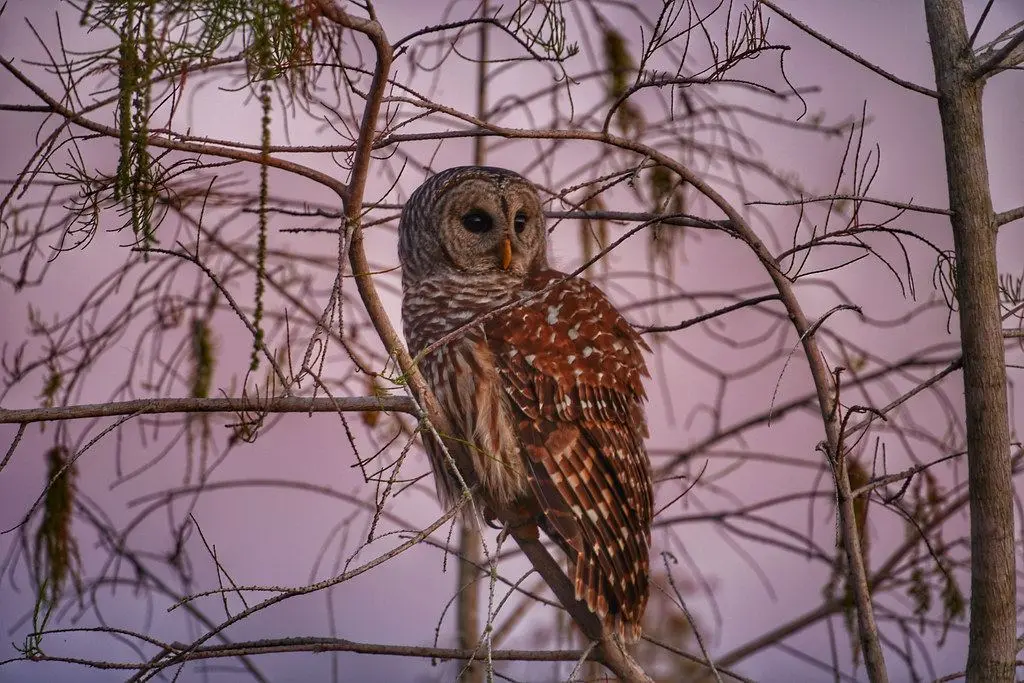
- Round head: there are no feather tufts on top, so the outline looks smooth.
- Dark eyes: most owls have yellow eyes, while a barred owl’s are brown and look almost black from a distance.
- Bars and stripes: horizontal bars cross the upper chest, and vertical streaks run down the belly. That pattern gives the bird its name.
- Size: Audubon lists a length of 17 to 20 inches and a wingspan of about 3 feet 3 inches to 3 feet 7 inches. Females are noticeably larger than males.
Great horned owls are the most likely source of confusion, but they have prominent ear tufts and yellow eyes. Great horned owls are also more aggressive, and Audubon notes that barred owls are the less aggressive of the two.
Where They Live
Barred owls are forest birds. Audubon lists dense woods, wooded swamps, and river bottoms as typical habitat. They favor large, unbroken forests, particularly old growth, partly because older trees offer the big hollows they need for nesting. If you live near a sizable stretch of mature woods, it’s worth a listen.
They’re permanent residents, so an owl you hear in January may be in the same area all year. That’s a real plus for anyone hoping to get to know a local bird over time.
What’s on the Menu
Barred owls aren’t picky. Small mammals make up most of their diet, especially mice and other rodents, along with squirrels, rabbits, opossums, and shrews. They also take birds, frogs, salamanders, snakes, lizards, and some insects. They’ll also catch crayfish, crabs, and fish.
That taste for crayfish produces one of the odder facts about this owl. According to the National Zoo, barred owls that eat a lot of crayfish can develop pink-tinged breast feathers.
Their hunting style is mostly about patience. An owl watches from a perch or flies low through the forest, sometimes hovering before dropping onto prey with its talons. Audubon says they may hunt at any hour, perhaps most often at dawn and dusk.
Raising a Family
Barred owls usually nest in a large natural hollow or a broken-off snag, though they’ll also take over an old nest built by a hawk, crow, or squirrel. In the East, they often reuse old red-shouldered hawk nests.
A clutch is two to five white eggs, which take 28 to 32 days to hatch. The chicks fledge at around 5 to 6 weeks old.
A Bird on the Move
Audubon considers barred owls widespread and common, with a population of about 3.5 million and a status of Least Concern. Their range has also grown. In recent decades they’ve spread into the Pacific Northwest, where they compete and sometimes hybridize with the smaller spotted owl. That has made them a conservation concern in that one region, even though they’re doing well overall.
Listening From Your Own Backyard
If you live near woods, try stepping outside on a calm evening in late winter or early spring. Turn off the outdoor lights, wait a few minutes, and listen. If you have large old trees on your property, consider keeping them when it’s safe to do so, since hollows and broken-off snags are the nest sites these owls rely on.
Want to learn about more of the animals around you? Browse our animal facts section. And the next time something in the dark asks who cooks for you, you’ll know who’s asking.
Sources: Audubon Guide to North American Birds; Smithsonian’s National Zoo.