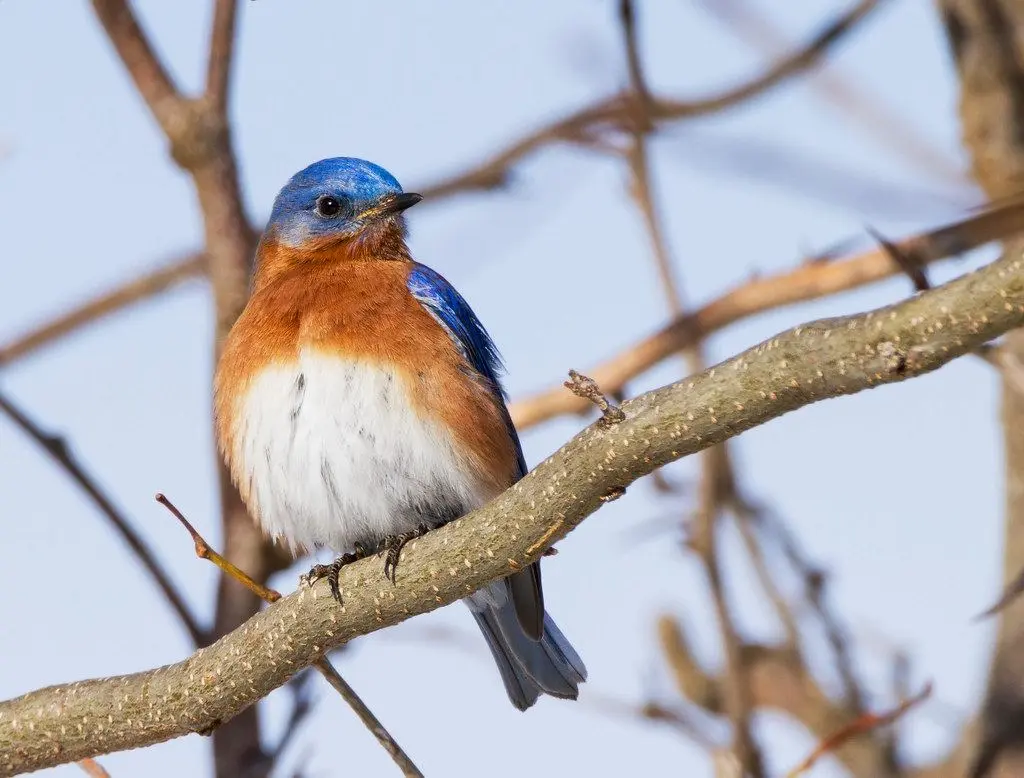
A flash of blue drops from a fence post into the grass, grabs a beetle, and flies back up. If your yard has some open space, you may be closer to hosting eastern bluebirds (Sialia sialis) than you think.
These birds nest in cavities, such as old woodpecker holes and hollow trees, and they will readily use a birdhouse. Good boxes have made a real difference. Audubon notes that eastern bluebirds declined badly in many areas as habitat and nest sites disappeared, and that their numbers have been rising again in recent decades, helped along by birdhouses. A single box won’t bring them back on its own, but it does give a local pair one more place to raise a family.
Check Whether Your Yard Fits
Bluebirds hunt by watching from a low perch, then dropping to the ground for insects. That is why they favor grassland and open woodland over dense trees or tight suburban lots. Crickets, grasshoppers, beetles, and spiders are all on the menu, and in winter they turn more to berries and other wild fruit.
A yard with short grass, a few scattered trees, and nearby fence lines or wires is a promising start. If your space is small and heavily shaded, you may get other cavity nesters instead, and that’s a fine outcome too.
One note on geography: eastern bluebirds live east of the Rockies. If you garden farther west, your local birds may be western or mountain bluebirds, so check what’s found in your state before you build.
Choose the Right Box
Size matters more than decoration. These are the main details to look for:
- Entrance hole: buy a box or follow plans made specifically for eastern bluebirds, so the opening is the right size. An oversized hole can let in bigger competitors like European starlings.
- Floor: about 5½ by 5½ inches, per NestWatch’s nest box guide.
- Depth: about 9 inches, which gives the nest some distance from the opening.
- A door that opens: you’ll need to look inside and clean the box, so pick one that opens easily.
Where to Put It
Placement decides whether a good box gets used. NestWatch’s suggestions are simple:
- Height: mount the box 4 to 6 feet off the ground. That is high enough to be useful and low enough for you to reach.
- On a pole: NestWatch suggests a pole mount. A predator guard on the pole can also make it harder for climbing animals to reach the nest.
- Facing: point the entrance east, toward open habitat.
- Spacing: keep bluebird boxes about 300 feet apart, since nesting pairs need their own territory.
If tree swallows are taking over, try pairing boxes. Place two boxes 15 to 20 feet apart, with about 300 feet between each pair. Each species tends to defend its box against its own kind, so a swallow in one box can leave the other open for bluebirds.
What Happens After They Move In
The female does most of the building, weaving a loose cup of weeds, twigs, and dry grass and lining it with finer material. The Missouri Department of Conservation reports clutches of 2 to 7 eggs and typically two broods a season, so one box can stay busy through the summer. Parents feed the nestlings insects, which supply the protein that growing young need.
Looking in on the nest is fine if you do it gently. A quick weekly check tells you how things are going and lets you spot trouble early. Open the door slowly, don’t handle the eggs, and keep the visit short. Sialis.org, a long-running bluebird resource, warns against disturbing the nest once nestlings are about 13 days old, because they may leave too early.
Dealing With Competitors
House sparrows and European starlings are nonnative birds that compete hard for nest sites. The Missouri Department of Conservation names them as a continuing concern for bluebirds. House sparrow nests are usually messy heaps of grass and litter, often with bits of trash mixed in, while a bluebird nest is a tidier cup.
Be sure of what you’re looking at before you remove anything. Native birds and their active nests are protected by federal law, so a chickadee or tree swallow nest has to stay put. If house sparrows are a constant problem, moving the box farther from buildings and feeders can help, because they tend to stick close to people.
Clean Out Between Broods
Once a brood has fledged, remove the old nest so the box is ready for the next round. Close the box up neatly, and check for damage while you’re there. An entrance chewed wider by a squirrel, for example, should be repaired or fitted with a hole guard.
Be patient if nobody shows up the first spring. Birds choose nest sites for their own reasons, and some boxes take time to get noticed. Leave it up, keep it clean, and enjoy whoever arrives. You can find more ideas for your yard in our backyard birds section.
Sources: NestWatch, Cornell Lab of Ornithology; Audubon Guide to North American Birds; Missouri Department of Conservation; Sialis.org.